
Data center demand is not slowing down. It’s accelerating and reshaping where and how construction happens. AI, cloud expansion, and digital infrastructure are driving one of the largest construction cycles in decades. But the core data center is only the starting point. The real opportunity is what follows.
Every hyperscale project sets off a multi-year expansion across infrastructure, industrial, residential, and community development. For every $1 invested in a data center, roughly $0.74 flows into adjacent construction activity.
At the same time, power constraints, land availability, and regulatory pressure are pushing development into new and secondary markets. That shift is creating earlier entry points for firms that understand how the cycle unfolds.
Knowing where data center activity is happening is step one. Next, you need to know what’s coming and when to act.
How To Turn Activity Into Opportunity
The halo effect follows a predictable sequence, but most firms don’t move quickly enough. They enter when bids have already been awarded, land prices have increased, and competition has compressed margins.
The advantage comes from aligning with the timeline before demand peaks. If you understand how each phase unfolds, you can:
- Target the right project types at the right time.
- Move into emerging corridors before they mature.
- Build relationships before procurement begins.
- Protect margins by avoiding crowded bid cycles.
It’s not about predicting the market but reading the signals already in motion.
A Timeline for Tracking Data Center Halo Effect Construction Opportunities
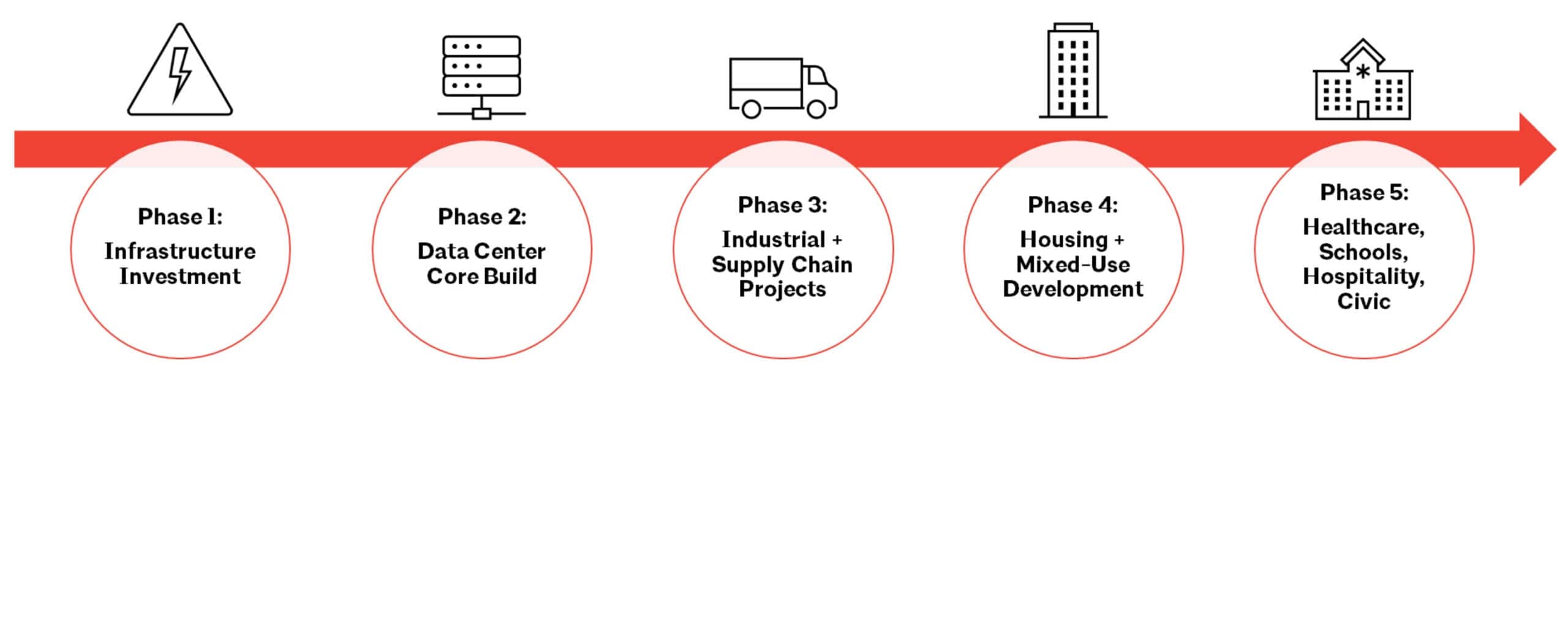
Phase 1: Infrastructure Investment Signals Where Growth Will Land
The first signal is not a building. It is infrastructure.
Before a data center breaks ground, hyperscale operators secure power, fiber, and water. Utilities begin expanding capacity, often years in advance. This is becoming more critical as AI workloads increase energy demand and strain existing grids, forcing major investment in power infrastructure and transmission.
The economic data support this trend. ConstructConnect’s Construction Economy Snapshot for March 2026 reports that power infrastructure grew 30% in February 2026, a 12-month rolling average growth rate.
What to watch:
- Substation approvals and long-lead equipment orders
- Utility capital investment and transmission upgrades
- Land acquisition near high-capacity power corridors
What It Means for You: This is the earliest entry point. It is where developers secure land, and where forward-looking firms establish their position before the market becomes visible.
Phase 2: The Core Build Confirms the Market
Once construction begins, the signal becomes undeniable.
This phase includes:
- Site development and core and shell construction
- Mechanical, electrical, and cooling systems
- Utility integration and specialized infrastructure
ConstructConnect’s Construction Economy Snapshot for March 2026 reports that the biggest dollar gains for Nonresidential Building came from offices, including data centers, up $10.3 billion (or +1,364%) year-on-year. Data center spending accounted for nearly 90% of the total category spending in 2025.
But this phase is not where most firms will win work. The next three phases are where the opportunity lies.
What It Means for You: Treat the core build as confirmation, not the opportunity. It validates that downstream demand is already forming.
Phase 3: Industrial and Supply Chain Projects Move First
The first wave of accessible work appears quickly. As construction ramps up, suppliers, manufacturers, and logistics providers follow the investment into the market. These projects often emerge within 12 to 24 months and scale rapidly.
This includes:
- Warehouses and distribution centers
- Manufacturing and assembly facilities
- Logistics and supply chain infrastructure
What It Means for You: This is an early, high-volume entry point. Firms that are already positioned locally are the ones that capture it.
Phase 4: Housing and Mixed-Use Development Scale the Market
As jobs are created, the population follows, and so does demand for housing and services. A single large-scale data center can generate tens of thousands of construction jobs and thousands of permanent roles, accelerating population growth in surrounding areas.
Key opportunities:
- Multifamily and workforce housing
- Retail centers and mixed-use development
- Office space supporting new business activity
This phase typically appears 12 to 36 months after groundbreaking. In many markets, this is where the largest volume of accessible projects emerges.
What It Means for You: This is where the halo effect becomes visible to the broader industry, but early movers are already established.
Phase 5: Institutional Development Locks in Long-Term Demand
The final phase reflects sustained population growth and economic expansion.
This includes:
- Healthcare facilities
- Schools and universities
- Hospitality and civic infrastructure
Institutional categories continue to show steady activity, reinforcing long-term demand tied to population and workforce growth. This phase typically appears three to seven years after initial development.
What It Means for You: This is the long tail of the opportunity. Firms that enter early often carry relationships and repeat work into this phase.
The Biggest Shift: Opportunity Is Moving to New Markets
One of the most important changes in this cycle is where growth is happening. Power availability, land constraints, and regulatory pressure are pushing development beyond traditional hubs into secondary markets.
That creates a powerful window of opportunity for less competition, lower land costs, and earlier positioning. But only for firms that move before the pipeline is obvious.
How To Act Once You Know Where Data Centers Are
Once you identify where data center activity is occurring, the next step is to act with precision.
Use this framework:
- Track infrastructure investment before major announcements.
- Align your services to the phase of development, not the headline project.
- Build relationships with developers, utilities, and municipalities early.
- Prepare contract strategies before project volume increases.
- Develop your pitch book with case studies that align with the type of work.
Turn Data Center Activity Into a Predictable Pipeline
You now understand how the opportunity unfolds. You can see where infrastructure signals appear first, how industrial and housing demand follow, and when institutional projects begin to take shape. This is the difference between reacting to the market and positioning ahead of it.
But timing alone is not enough. The next step is knowing how to enter these markets, build the right relationships, and secure work before competition increases. See how contractors and developers are winning work in these corridors.
Explore the Data Center Heatmap to see where activity is happening and identify where your next projects will emerge.
