
How General Contractors Can Use AIA Document Pairings To Align Risk, Coordinate Subcontractors, and Keep Projects Funded
Winning a bid is an important project milestone. It marks the shift from the planning of pricing and proposals to the reality of executing the work.
The structure and completeness of your construction contract documents shape how smoothly, or painfully, that execution unfolds.
Any project can have challenges:
- A subcontractor could push back on terms.
- A pay application could be returned for revisions.
- A change order could sit unresolved longer than it should.
When issues start to stack up, work slows down.
Why Contract Alignment Matters for General Contractors
Most general contractors don’t struggle because they lack documents. They struggle because those documents lack coordination, clarity, and consistency. As the GC, you sit in the middle: upstream to the owner and architect, and downstream to every subcontractor and supplier.
When agreements aren’t aligned:
- Risk isn’t clearly allocated.
- Responsibilities blur between parties.
- Payment processes don’t match contract requirements.
- Unresolved issues slow the work and erode profitability.
This is where a coordinated contract system makes all the difference.
A101: Start With the Right Contract Foundation
Every project starts with a core agreement. The industry-standard A101® – Agreement Between Owner and Contractor is used for projects with a stipulated contract sum. It establishes the project timeline and payment structure, while Exhibit A clearly sets insurance and bonding expectations.
A101 defines the business relationship and financial terms, but it is only the starting point. It requires General Conditions to complete the Contract for Construction and define how the work is performed.
The A101 sits at the center of any good contract system. Around it are the documents that:
- Define how work is done
- Align every subcontractor
- Further protect against risk
- Enable consistent cash flow
Core AIA Document Pairings for General Contractors
Build the Core Contract: A101 + A201
A201® – General Conditions of the Contract for Construction defines the general conditions that govern the business agreement set out in A101. The A201 outlines how the project is administered day to day, including:
- Roles and responsibilities
- Decision-making authority
- Change and claims processes
- Payment certification
Together, A101 and A201 form the full Contract for Construction, and using one without the other introduces risk and inconsistency.
Align Subcontractors: A101 + A401
As the general contractor, you’re responsible for coordinating every trade on the job. A401™ – Agreement Between Contractor and Subcontractor is your resource to align subcontractors. The A401 connects each subcontractor back to the prime agreement.
A401 defines:
- The lines of responsibility
- How risk flows between parties
- Pay application requirements
Without this alignment, each subcontract can become a silo, creating gaps that are difficult and time-consuming to manage.
Reinforce Trust with Bonds: A101 + A312
Winning work isn’t just about price. It’s about the owner’s confidence in your ability to deliver.
Performance and payment bonds reinforce that confidence:
- A312™ – Performance Bonds back your commitment to complete the work.
- A312™ – Payment Bonds protect the project from payment-related disruptions.
Aligned with your construction contract, these bonds signal financial strength, build trust with owners, and help limit your exposure if conditions change during the project.
Maintain Cash Flow: A101 + G702/G703
Work alone doesn’t trigger payment; billing documentation does.
G702® – Application and Certificate for Payment and G703® – Continuation Sheets streamline billing by:
- Tracking progress against the contract’s schedule of values.
- Standardizing calculations for retainage.
- Supporting the architect’s review and certification.
These billing forms connect directly back to the contract sum and payment structure defined in A101 and governed through A201. Consistent monthly progress payments are what keep cash flow predictable.
How the AIA Contract System Works Together
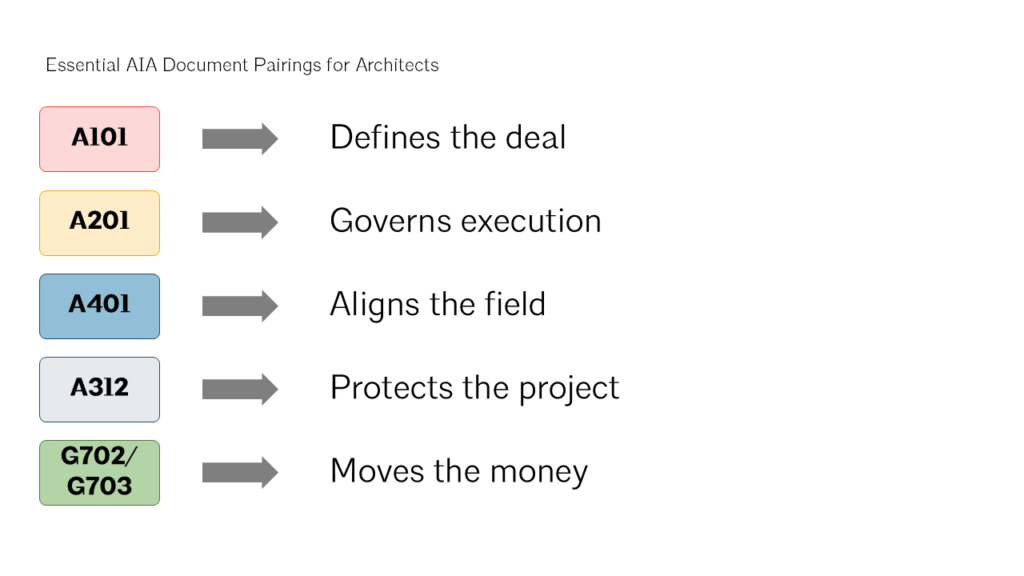
AIA documents are connected parts of the same system, offering risk protection across the entire project lifecycle.
Essential AIA Document Pairings for General Contractors
What Happens Without a Coordinated Contract System
When these pieces aren’t aligned from the start, the issues can quickly begin to arise in the form of:
- Subcontractors operating under inconsistent terms
- Payment applications that don’t match contract requirements
- Change orders that create friction instead of clarity
- Risk exposure through performance issues
The GCs who protect margins and keep projects moving don’t just manage the work; they start with a system that keeps everything aligned from day one. Because in construction, challenges are inevitable, but unmanaged risk doesn’t have to be.
Build Your AIA Contract System with Unlimited Access
Creating a consistent, scalable contract system doesn’t have to be frustrating. With an unlimited subscription to AIA Contract Documents, you’ll have access to our complete set of coordinated agreements that help you cut costs, protect margins, and deliver with confidence.