
Build Smart From the Start
In custom residential construction, most problems don’t start on site; they start in the agreement.
Too often, project agreements leave scope loosely defined, rely on assumed expectations, and handle changes informally, creating gaps that surface later.
What follows are unavoidable cost overruns, payment friction, delays, and strained relationships.
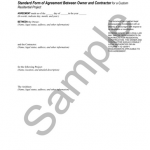
The A110™ – Agreement Between Owner and Contractor for a Custom Residential Project was developed to address these gaps as part of AIA’s coordinated residential contract framework. It gives project teams a clear, structured way to define scope, manage change, and align expectations before work begins.
Why the A110 Was Created for Custom Residential Projects
Custom residential projects operate differently from both commercial construction and production homebuilding. They are more personal, more iterative, and more dependent on ongoing decisions from the owner. Design continues to evolve during construction, and owners remain closely involved in selections and changes. No two projects follow the same path.
Traditional agreements were not built for this level of variability. That’s why the A110 agreement was created, to bring structure to this environment without overcomplicating it. It reflects how custom residential projects actually move, not how they are assumed to move on paper.
It is also part of the AIA coordinated set of residential construction agreements, giving teams a consistent, widely adopted foundation to work from.
At its core, the purpose of the A110 is straightforward:
- Define the work clearly
- Document decisions
- Align expectations early so the project runs with fewer surprises
How A110 Fits Within AIA Residential Contracts
The documents provide a consistent framework for residential construction that can be used together or alone based on the project structure.
- A110™ is used for custom residential projects with a contractor.
- A111™ is used when the builder performs construction only.
- A112™ is used when the builder provides both design and construction.
- B110™ governs the relationship between the owner and architect.
These agreements align the project team on design, construction, and decision-making.
When Should You Use the A110 Agreement?
The A110 is best suited for:
- Custom residential projects.
- Projects with a separate architect and contractor.
- Projects where design continues during construction.
- Owners who want structured visibility into cost and changes.
How Does the A110 Agreement Benefit Homeowners?
A110 Creates Visibility for Homeowners
For homeowners undertaking a custom home, the biggest challenge is often not the construction itself, but the uncertainty around it.
- What exactly is included in the contract?
- How will pricing adjust as decisions evolve?
- What happens when changes are made mid-project?
The A110 agreement addresses these questions by making the process visible. Instead of relying on assumptions, owners work within a structure that outlines how scope is defined, how costs are developed, and how decisions are approved. This creates a more predictable experience, even if the project is inherently flexible.
A110 Manages Changes for Homeowners
Equally important is how the agreement handles change. In custom residential construction, change is expected. What matters is whether it is managed.
The A110 establishes a clear process for reviewing, pricing, and approving changes before work proceeds. This allows homeowners to make informed decisions with a clear understanding of cost and schedule impact, reducing the likelihood of surprises later in the project.
Because the agreement is developed through AIA’s consensus-based process, it is designed to be balanced and aligned with industry best practices. Owners are not relying on a one-sided contract, but on a widely accepted standard.
How Does the A110 Benefit General Contractors?
A110 Addresses Risks for General Contractors
For general contractors, the risks in residential construction are well known. Unclear scope leads to rework. Informal changes lead to unpaid work. Misalignment slows execution and creates friction with clients.
The A110 agreement addresses these risks by putting structure around the parts of the project that typically create the most exposure.
Scope is defined more clearly from the outset, reducing ambiguity about what is included in the work. Responsibilities are outlined so that roles are understood across parties. Expectations around owner involvement are documented, which is critical in custom residential work.
A110 Manages Changes for General Contractors
Where the agreement delivers the most operational value is in how it manages changes. Instead of reacting after the fact, the A110 establishes a consistent process to evaluate changes before work is performed. Pricing, approvals, and schedule adjustments are documented in a way that protects the contractor’s ability to get paid for the work performed and maintain control over the project timeline.
Over time, this level of consistency improves how projects run. Decisions happen faster. Communication is clearer. Fewer issues escalate into disputes.
Using a recognized AIA standard agreement also reinforces credibility with homeowners who expect a professional, transparent approach to managing their project.
Why Does the A110 Agreement Matter Early in the Project?
Most teams focus on design direction, budget, and assembling the right participants. The contract is often treated as something to finalize later.
But in practice, the agreement shapes how all these decisions play out. It determines how scope is defined, how money moves, how changes are handled, and how issues are resolved. Waiting to address the agreement last often means carrying unnecessary risk into the project.
Understanding the A110 agreement early allows owners and contractors to align on how the project will operate before momentum builds. It creates a foundation for better decisions, not just better documentation.
A Better Foundation for Custom Residential Construction
Custom residential construction will always involve complexity. The goal is not to eliminate it, but to manage it with clarity. The A110 agreement was created to do exactly that. It provides a shared framework for homeowners and contractors, defining residential construction work, managing change, and reducing uncertainty across the life of the project.
In practice, that clarity is what leads to fewer disputes, stronger alignment, and better project outcomes.
Explore the A110 and the full suite of AIA residential contract documents.
Unlimited Access To AIA Contract Documents
Access the full library of AIA agreements with an annual subscription built to support every stage of your project.