
How To Align Responsibilities, Reduce Risk, and Support Better Project Outcomes with AIA Contract Pairings
Construction projects don’t fail because of one bad contract. They fail because contracts don’t align.
An architect’s agreement with the owner, the contractor’s agreement for construction, and consultant agreements are all interconnected. When these documents are coordinated, projects run smoothly. When they’re not, gaps, overlaps, and disputes emerge.
Understanding how AIA Contract Documents (ACD) work together—not in isolation—is critical to reducing risk and improving project outcomes.
Why Document Pairing Matters
AIA Contract Documents are designed as a system of coordinated agreements.
Each document:
- Defines roles and responsibilities
- Allocates risk
- Establishes expectations
But the real value comes from how they connect across the project team.
| When documents are properly paired | When they are not |
|---|---|
| Responsibilities are aligned across parties | Teams rely on assumptions |
| Scope gaps are reduced | Scope overlaps or disappears |
| Communication becomes clearer | Disputes become more likely |
| Risk is more effectively managed | Misalignment creates confusion and downstream risk |
The Foundation: B101 as the Starting Point
At the center of most project agreements is B101 -Standard Form of Agreement Between Owner and Architect.
B101 establishes:
- The architect’s scope of services
- The standard of care
- The architect’s relationship with the owner
Every other agreement should align with the commitments made here.
There’s a reason 92% of architecture firms rely on it. The B101 defines scope, compensation, and professional responsibility. But the real benefit is how it aligns with other agreements that support the project.
Core AIA Document Pairings Every Architect Should Know
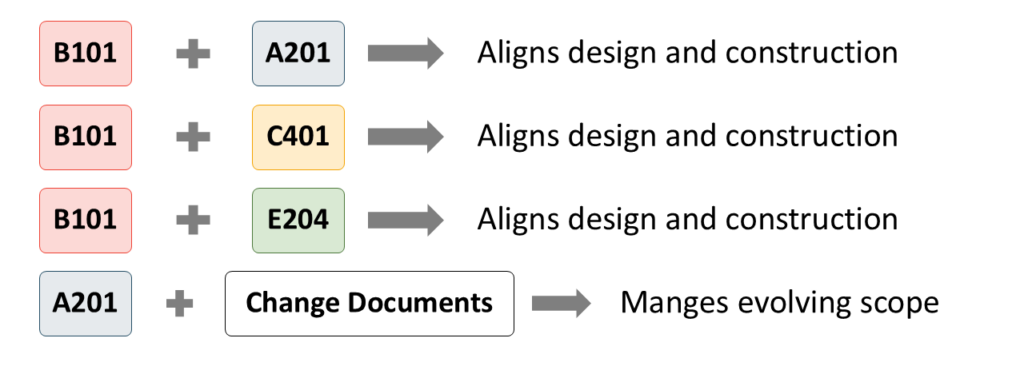
B101 + A201: Aligning Design and Construction
The pairing of B101 and A201® – General Conditions of the Contract for Construction connects design intent with project execution.
- B101 defines the architect’s services
- A201 defines how the project is built, administered, and managed
Together, they:
- Establish the architect’s role during construction.
- Define communication protocols between owner, contractor, and architect.
- Create a shared framework for project administration.
Read our article for a deeper breakdown on how B101 and A201 work together in construction administration.
B101 + C401: Coordinating Consultants
When architects engage consultants, the C401™ – Agreement Between Architect and Consultant the ensures alignment with the architect’s obligations under B101.
This pairing:
- Extends responsibilities from architect to consultant
- Supports coordination across disciplines
- Reduces gaps in scope and responsibility
Learn more about how to protect your company’s chain of responsibility.
B101 + E204: Integrating Sustainability Goals
For projects with sustainability objectives, E204™ – Sustainable Projects Exhibit works alongside B101 to define expectations and responsibilities.
This pairing:
- Establishes sustainability goals (e.g., LEED® certification)
- Defines roles across the project team
- Aligns documentation and performance expectations
Learn more about aligning sustainability goals and how the E204 works with B101.
A201 + Change Management Documents: Controlling Scope
Scope changes are inevitable—but disputes don’t have to be. A201 works with key documents such as:
- G701™ – Change Order
- G714™ – Construction Change Directive
- Amendments and supplemental agreements
Together, they provide a structured system for managing change. Learn more about how to prevent scope-related disputes.
How These Pairings Work Together as a System
Each pairing solves a specific coordination challenge. Together, they form a complete contract ecosystem.
A 5-Step Framework for Coordinating Agreements
To ensure your contracts are aligned, consider this approach:
- Start with the Owner-Architect Relationship: Define expectations clearly in B101.
- Extend Responsibilities Across the Team: Use coordinated agreements (C401, A201, E204) to align all parties.
- Plan for Change: Incorporate structured tools for managing scope adjustments.
- Maintain Alignment Throughout the Project: Revisit agreements as the project evolves.
Why This Matters for Architects
Architects don’t just design buildings—they help define how projects function.
By coordinating agreements:
- You reduce ambiguity across the team.
- You improve communication and decision-making.
- You help prevent disputes before they arise.
Building a More Connected Contract Strategy
AIA Contract Documents are designed to work together—but only when used as a system. Understanding essential document pairings allows you to:
- Create alignment across all parties
- Reduce risk exposure
- Support smoother project execution
Keep Your Agreements Aligned Across Every Project
Coordinating multiple agreements doesn’t have to be complex. With Unlimited Access to AIA Contract Documents, you can work from a complete, integrated system designed to align roles, responsibilities, and risk across your entire project team.
Explore how going unlimited helps you simplify document coordination and strengthen your project framework.