
Lien waivers are incredibly useful. They make it easier and safer to release money on a project. When used correctly, they transfer risk at the appropriate time. Because lien rights are such a critical aspect of construction projects, it’s important to choose the right waiver, such as the AIA lien waiver forms discussed below, and use them responsibly.
The best use of lien waivers is to submit them with every payment application. Lien waivers are often a required part of the pay app submission process, but even if they’re not explicitly required, it’s a good idea to send one anyway.
What Is Included in a Payment Application?
The term “payment application” or “pay app” refers to a bundle of documents submitted to receive a progress payment or final payment.
Standard Documents in a Pay App
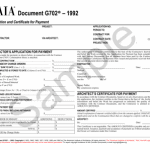
Payment applications include G702® – Application and Certificate for Payment as well as supporting documentation, including:
- Invoices
- Continuation sheets
- Schedules of values
- Lists of subcontractors and suppliers
- Relevant change orders or change directives
- Daily reports or photos
At project closeout, G706™ and G707™ are also standard components of a complete payment application. These documents are all governed by the payment provisions in A201®.
Who Sets Pay App Requirements?
The required documents are usually dictated by the general contractor, owner, owner’s agent, or a combination of the parties.
Why Lien Waivers Are Often Required
Required lien waivers must be included to ensure approvals and payments aren’t delayed. But even where lien waivers are not specifically required, it’s still a good idea to send them.
Savvy project leads will include a mandate for lien waivers. If a lien waiver is required, submissions without it will be rejected, even if it wasn’t explicitly stated initially. When a lien waiver is included, whoever’s reviewing pay apps might be more inclined to let minor errors slide, because they know that the most important issues are accounted for.
How Lien Waivers Keep Money Moving Through the Project
Consider how individual lien waivers from subcontractors and suppliers fit into the bigger scope.
General Contractors Bundle Pay Apps and Waivers
On a large project, a general contractor may gather pay apps from several subs and suppliers. The general contractor then submits the bundled pay apps up the chain to release payment. Once approved, the payment is released to the contractor. Funds don’t flow down the payment chain until the contractor gets paid.
Why Missing Documents Stall Payments
Incomplete document submissions to the general contractor can slow down or even stall payments. That’s why lien waivers are so critical; they provide peace of mind when payments are released.
If other documents are left out or aren’t perfect, a lien waiver can help to keep money moving.
How a Lien Waiver Speeds Up Pay App Reviews
A lien waiver is a promise not to file a lien if payment is made (depending on the terms of the waiver). When requesting payment, the lien waiver gives the reviewing party confidence to release payment, increasing the likelihood that they do so quickly.
Eliminating Back-and-Forth Delays
Failure to include a lien waiver with your pay app could be viewed as a simple clerical error, delaying payment until the lien waiver is sent. It could also be seen as a potential red flag that something is wrong with the work, the subs/suppliers, or something else in the project scope.
How Lien Waivers Provide Payment Peace of Mind
Nobody wants to deal with a lien on their project, from the owner down to the sub-subcontractor’s material supplier. A lien filed somewhere along the payment chain often means that money stops flowing for everyone.
That’s why proactively sending lien waivers can provide peace of mind.
Reducing Fear of Hidden Disputes
For the party releasing payment, one of the biggest risks is that an unknown dispute may prevent funds from being properly dispersed, resulting in a lien. Sending a waiver can reduce this concern. When used properly with the correct form, rights won’t be waived until payment is made.
Sending Lien Waivers Builds Trust Across the Payment Chain
At a high level, proper lien waiver usage and submissions create trust in the project. The general contractor or project lead reviewing pay apps can trust that subcontractors and suppliers won’t file a lien if they’re paid.
On the other hand, lien rights are a powerful payment tool. Subcontractors and suppliers waiving their lien rights are trusting the higher-ups will do their part and release payments.
Strengthening Long-Term Business Relationships
These granular transactions are useful. But even more valuable is the continuous trust building, both within the same project and across multiple projects spanning months or years, that creates healthy working partnerships and recurring business.
When everyone trusts that everyone else will do their job and be paid fairly, it’s easier to focus on the on-site work rather than what’s back in the office.
Choosing the Right Lien Waiver for Each Pay App
The project location and status determine the appropriate lien waiver.
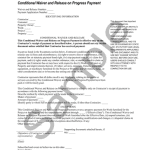
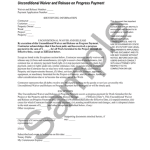
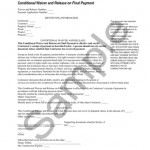
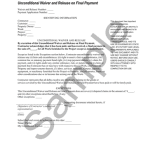
Most states do not have statutory forms, but if you’re in a state that regulates lien waivers (such as California or Florida), it’s important to use the correct statutory form(s). For projects not subject to state-specific requirements, AIA publishes standard lien waiver forms G901™, G902™, G903™, and G904™) covering conditional and unconditional waivers for both progress and final payments.
Understanding Progress Lien Waivers vs Final Lien Waivers
There are four main types of lien waivers.
Conditional Progress (Partial) Lien Waiver
Partial lien waivers are most appropriate when a portion of the work is complete, and the sender wants to partially waive their lien rights in exchange for a progress payment.
If the work is not complete, it’s probably too early to send a final waiver. If payment hasn’t been made, it’s best to send a conditional waiver.
Unconditional Progress (Partial) Lien Waiver
Unconditional progress waivers are most appropriate when payment has already been made for the given portion of the work.
Most parties don’t want to send unconditional waivers until after payment has been made. Additionally, if the work is finished, a final lien waiver may be more appropriate.
Conditional Final Lien Waiver
These waivers are most appropriate when the sender’s work is substantially complete, but payment hasn’t been made.
If payment has been made, an unconditional waiver may be in order (though they’re not always necessary). If there is substantial work remaining beyond warranty work or minor “punch list” items, a partial waiver might be better.
Unconditional Final Lien Waiver
These waivers completely waive all lien rights. Typically, they are only appropriate if the work has been completed and paid for.
While technically not necessary in most situations, these waivers do provide peace of mind to general contractors, owners, and project leaders, so they may be requested to put a final stamp of completion on a project. This ensures no future claim will surprise anyone on the job.
Improve Your Lien Waiver Process
You’re probably already submitting lien waivers, and it’s natural to have reservations or concerns while doing so. Understanding exactly how lien waivers work makes it easier to send them up the chain without fear that you have prematurely waived your rights.
It’s important to know the types of lien waivers, have a standardized set of templates like AIA lien waiver and release forms, and stick to your company’s internal lien waiver policy.
With that infrastructure in place, it will be easier and safer to send lien waivers with every pay app.