
Subcontractor Alignment Starts with the Right Contract Structure
Your A101 has been signed, and your next project is kicking off. Once you assemble the subcontractors and trade specialists, the project picks up speed, and the number of agreements grows quickly. Five, ten, twenty trades, each with its own scope, schedule, and business terms, and they’re all expected to perform under your overall project expectations.
That only works if they’re operating from the same foundation.
A401 Extends Your Prime Contract to Every Subcontractor
As a general contractor, A101® defines your agreement with the owner, and A201® defines how the work is administered. These general conditions protect the construction contract.
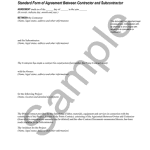
AIA A401™ – Agreement Between Contractor and Subcontractor is the standard form agreement between a general contractor and their subcontractor. It mirrors the structure of your A101 and A201, carrying the same terms, obligations, and expectations to every subcontractor on the project.
Without that connection, you’re not managing one cohesive project; you’re managing multiple versions of it.
Standardize Subcontracts to Keep Projects Aligned
Standardization isn’t just about efficiency. It’s also about alignment.
How A101, A201, and A401 Work Together
The relationship is straightforward but critical:
- A101 establishes the financial terms and overall obligations.
- A201 defines how the project is executed.
- A401 flows those same terms and expectations to every subcontractor.
How A401 Aligns Subcontractors with Your Prime Contract
A401 doesn’t introduce a new system. It mirrors the one you’ve already agreed to and extends it downstream.
That alignment shows up in the details that drive the job.
- Payment structure: Subcontractor pay applications align with your A101 schedule of values and the billing cycle. When all crews submit their billing requirements in sync, project funding proceeds seamlessly.
- Pay-when-paid expectations: Timing of payment delivery to your subs stays consistent with your upstream agreement.
- Lien waivers and documentation: Subcontractors provide the same supporting documentation required for owners to release payments with confidence.
- Insurance and additional insured status: Coverage requirements match what you’ve committed to in A101 Exhibit A and extend to crews appropriately.
- Risk allocation alignment: Liability, indemnification, and responsibility provisions reflect the same risk structure defined in your prime agreement.
- Scope clarity across trades: Each subcontract clearly defines responsibilities to prevent overlaps, gaps, and conflicts between teams.
- Submittals and project documentation: Teams are working from the same drawings, specifications, and enumerated contract documents.
- Schedule coordination: Subcontractor timelines align with the overall project schedule and sequencing requirements.
What Happens When Subcontract Agreements Aren’t Aligned
As a general contractor, you sit in the middle of the project. Upstream, you’ve committed to the owner under A101 and A201. Downstream, you rely on subcontractors to fulfill those same obligations.
If those agreements aren’t aligned, the gaps don’t disappear; they shift to you.
When subcontract terms drift from the prime contract:
- Payment timing becomes inconsistent.
- Scope responsibilities blur between trades.
- Risk isn’t clearly transferred.
- Disputes take longer to resolve.
What should be a coordinated system becomes a series of exceptions.
Turn Contract Alignment into Faster Field Execution
Subcontract agreements are often where projects lose momentum, not because they’re complex, but because they’re inconsistent.
How High-Performing GCs Standardize A401
Efficient teams don’t rebuild subcontracts from scratch. They standardize A401 to reflect their A101 and A201 structure and reuse it across projects.
Using A401 as a base, they:
- Customize once to match their prime contract terms.
- Start each contract with a consistent project template.
- Apply the same payment, insurance, and documentation requirements across all trades.
- Adjust only scope-specific details.
- Execute quickly without reworking core terms.
This is both faster and cleaner. Subcontractors know what’s expected. Documentation aligns from day one. Payment flows with fewer disruptions.
Pressure-Test Your Subcontract Alignment
Before issuing subcontracts, pressure-test alignment:
- Do your subcontracts mirror your A101 and A201 terms?
- Do your A401 agreements reflect your A101 payment structure and timing?
- Are lien waivers and documentation requirements consistent across all trades?
- Is your schedule clearly reflected in subcontract obligations?
- Is the scope clearly defined and coordinated between subcontractors?
- How quickly can you turn around subcontract agreements after award?
The work doesn’t start when the contract is signed. It starts when your subcontractors are aligned and in the field. When you work from a system in which contracts are consistent, it’s easier to align risk and accelerate both setup and execution.
Build a Scalable Subcontract System with A401
With the right contract platform, you can quickly organize every phase of every project. AIA Contract Documents’ Unlimited Subscription includes access to A401, A101, A201, and every coordinated agreement you need to efficiently manage your subcontractor networks.