

This guide breaks down how strategic contracting reduces risks, protects cash flow, and prevents avoidable losses. We help general contractors (GCs) start projects faster by getting contracts right before work begins. AIA Contract Documents draws on experience from partnering with 92% of the ENR 400 across 200,000 projects annually. Whether you’re running a local operation or constructing on a national scale, this resource is for you.
Protect the Project Before Breaking Ground
Congratulations! You have won the bid. But before the trucks roll in, remember construction is a risky business. That’s where the contract comes in. A strong contract defines how GCs collaborate with owners, architects, and subcontractors long before crews arrive onsite.
AEI Consultants stresses why contracts are step one: “Stakeholders must have a clear and comprehensive contract management system in place to reduce the risk of disputes over contractual obligations or payment terms.”

The Top 4 Ways Contracts Support Your Build
Risk Distribution: Well-written contracts keep design risk with the architect, where it belongs. As the general contractor, a contract clearly outlines where you take on risk during construction.
Insurance Protections: A contract ensures you can secure the insurance and bonding required to safeguard your team’s well-being and the business’ financial security. Without the right contract language, insurance and bonding either become more expensive or unavailable.
Profitability: In construction, the cost of goods determines whether a project is profitable. Your primary agreement accounts for dynamic material pricing.
Scheduling: Weather and supply chain conditions play an outsized role in projects running according to plan. Construction is beholden to the domino effect. Contracts account for expected delays before schedule risk shift onto the GC.
Types of Development
General contractors work across a wide scope of project types. AIA Contract Documents have been upheld in court with jobs of every scale. This ranges from complex, high-profile facilities, like the Dallas Cowboy’s Stadium, to local residential and mixed-use buildings. These agreements are widely accepted across the U.S. construction market. They support common projects such as office buildings, retail and hospitality spaces, multi-family housing, healthcare, and education facilities.
Based on current Construction Connect data, development areas seeing rising demand include:
- Data centers and warehouses
- Public infrastructure projects
- Semiconductor and biomanufacturing facilities
- Large industrial and megaprojects exceeding $1 billion
These project types involve complex scopes, tight schedules, and multiple stakeholders. By using standardized, well-coordinated contracts, you can effectively manage risk and execution.
AIA Contract Documents Are Built for the Entire AEC Team
Contracts help you bring the architect’s vision to life while meeting the owner’s needs and protecting your firm’s bottom line. The contracts support collaboration and risk allocation from preconstruction through closeout. These documents reflect broad industry experience, not a single point of view. AIA Contract Documents are written by a 35+ member Documents Committee, including contractors, owners, architects, attorneys, and insurance professionals from the AEC industry. Their collective perspective results in agreements that are widely recognized and practical to use in the field.
The General Contractor Is the Hub of the Contracting Environment
Contracting in construction spans a wide range of agreements (A-Series) and billing forms (G-Series). The GC coordinates the largest volume of documents. You manage subcontractors, trades, and suppliers, and have oversight of their payment applications. Because of this complexity, misaligned documents are one of the fastest ways GCs lose time, leverage, and margin.
From the general contractor’s seat, flow-down provisions are non-negotiable. The primary agreement between you and the owner sets the tone for the entire job. The General Conditions (A201) govern all architect, subcontractor, and consultant agreements by reference, and help to define rights, responsibilities, and relationships across parties
AIA Contract Documents align with delivery methods and publishing years. This ensures consistency from the primary agreement through payment certifications, substantial completion, and lien waivers.
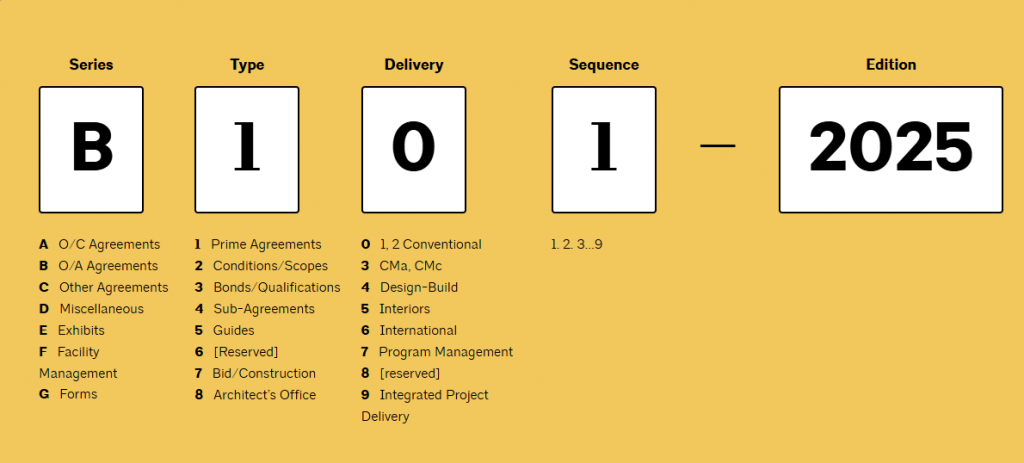
Defining the Contract Documents
Contract Documents are the full set of written and graphic materials that collectively define the agreement between the owner and the general contractor. They include the signed contract, terms and conditions, architect’s drawings, specifications, addenda, and any approved modifications issued after execution.
Traditionally, construction relied on two-dimensional drawings and static renderings to communicate design intent. As the industry continues its digital transformation, Building Information Models (BIM) are prevalent. These data-rich, 3D renderings show how building systems fit together. If used, the BIM Execution Plan (G203) is required.
Drawings are not reference materials; they are binding instructions your team builds from. Precision of these drawings is imperative. They are the documents your team relies on to plan schedules, procure materials, coordinate subcontractors, and execute the work.

Choosing Your A-Series Agreement
The primary agreement is the control document for the entire project. Every downstream obligation, risk, and payment term flows from it.
Traditional Design-Bid-Build
In Design-Bid-Build, first, the owner and architect work together to design the project. Once the design is established, the construction contract is awarded through a bidding process. This is where you come into the equation! Your responsibilities include construction execution and subcontractor coordination. You carry construction risk, but design responsibility remains with the architect.
Payment Models
In Design-Bid-Build, a key consideration is how the contract value is defined. Payment mechanics make up a significant part of a primary agreement. Selecting the wrong agreement can misalign financial risk, complicate payment administration, and increase disputes. That’s why getting this decision right from the onset matters.
Stipulated Sum (A101): This agreement assumes a fixed total payment value for the construction work. The contract value is not variable based on actual project costs. A101 works only if your estimating is disciplined and scope is tightly defined, otherwise, cost risk sits squarely with you.
Cost of the Work Plus a Fee with a Guaranteed Maximum Price (A102): This model requires detailed tracking of labor and material costs throughout the project. A102 protects the owner’s budget first, while limiting upside for the GC if costs escalate. The Guaranteed Maximum Price (GMP) establishes a ceiling on total compensation. Cost overruns beyond the GMP may impact your margins.
Cost of the Work Plus a Fee without a Guaranteed Maximum Price (A103): By contrast, Cost of the Work without a GMP can be advantageous for GCs, as cost overruns do not cap compensation. In this model, cost risk shifts to the owner.
AIA Contract Documents data shows a breakdown of payment model at 81% stipulated sum, 14% Cost+ GMP, and 5% Cost+ without a GMP.
Other Roles Your Construction Firm Might Be Hired For
Your construction firms may be hired in different capacities. Each role directly affects your risk, responsibilities, and contract strategy.
Design-Build Delivery Method
When your firm is hired as a Design-Builder, the contracting landscape changes significantly. And it’s likely you’ll find yourself in this position. A 2025 FMI Consulting study projects design-build is to account for $2.6 trillion of construction spending over the 2024 – 2028 forecast period, representing 47% of spending by delivery method.
In this role, you assume responsibility for both design and construction. The owner contracts the Design-Builder under A141. Design-Build increases your scope and risk because design performance, code compliance, and coordination are contractually linked to construction outcomes. The Design-Build delivery method streamlines coordination and accelerates decision-making.
Construction Management Roles
Construction management is a hybrid of the Design-Bid-Build and Design-Build. The GC enters the project earlier but is not responsible for the design itself. There are two ways you can be involved as a Construction Manager.
Construction Manager as Constructor (CMc): As a CMc, you provide preconstruction services and later transition into an at-risk constructor. While design liability remains with the architect, your early involvement increases responsibility for budget alignment, schedule strategy, and coordination decisions that influence the final design.
There are several contract options for the CMc role that correspond to the chosen payment model and delivery method including:
Construction Manager as an Advisor (CMa): When you serve as a CMa, you are engaged by the owner in a consultative role, typically beginning early in the design phase. Your responsibilities focus on preconstruction services. These include cost estimating, scheduling, constructability input, and coordination advice. This advisory role carries limited risk and does not take on construction. It is supported by A132 with A232 General Conditions.
Considerations for Alternative Starting Agreements
Home Builders: Homeowners have different expectations than corporate owners. AIA Contract Documents offer agreements tailored for residential construction to address these needs.
- A110 covers custom residential projects.
- A111 is for the construction of a single-family home.
- A112 is for the design and construction of a single-family home.
- A113 is appropriate for single-family home remodeling and renovations.
Integrated Project Delivery: You may also find yourself on an Integrated Project, which promotes collaboration throughout. A195 addresses the shared responsibilities and collaborative risk structure of Integrated Project Delivery. This arrangement has its own unique General Conditions under the A295.
Volumetric Modular Construction: This unique delivery method involves off-site construction of modular components in a controlled factory environment. These elements are then transported and assembled onsite as part of the final structure. Contracts address early procurement, logistics, and coordination between parties. The A181 with A281 General Conditions govern these projects.
Project Scale: Less complex builds call for streamlined agreements. The abbreviated contract, A104, includes its own conditions and is ideal when the scope is limited. The A105 is a short-form option best for small-scale jobs.
MSAs: To assist in long-standing developer relationships, you can enter into a Master Service Agreement (A121). In this collaborative mode, specific projects are defined and priced through Work Orders (A221).
The Anatomy of a Construction Agreement
General Information: This section identifies the parties to the agreement, including the owner, architect, and contractor, along with the project location and the designated representatives authorized to act on each party’s behalf.
Project Timeline: This section defines when work can begin, when Substantial Completion is expected, and what level of work would be completed by that point. At Substantial Completion, occupancy is turned over to the owner, and the project can be used for its intended purpose, while minor punch list items are finalized.
Contract Value: This section defines the total value of the construction contract and includes tables that support how the work is priced. This section varies between payment methods:
- Under the A101, the stipulated sum establishes a fixed contract amount. Incentives or bonuses allow the Contract Sum to increase for early completion or strong performance.
- Under the A102, Cost Plus with a GMP, the Contract Sum section establishes active cost controls throughout the project. The general contractor’s fee is clearly defined and tracked separately from job costs. The contract tightly defines what qualifies as reimbursable costs. The contract requires open-book accounting, detailed cost records, and audit rights during and after construction.
- Under the A103, Cost Plus without a GMP, the Contract Sum is based on the actual Cost of the Work plus a clearly defined general contractor’s fee, but without a hard cost cap. The contract strictly defines reimbursable costs, requires open-book accounting, detailed cost reporting, and owner audit rights. The contract relies on a Control Estimate that is updated throughout the project to track budget, assumptions, contingencies, and projected final cost.
Across all valuation models:
- Alternates give the owner flexibility to make design or material selections later, such as choosing between different flooring or finish options.
- Allowances address cost uncertainty. At the time of contracting, some materials may not yet be selected, so budgets are assigned to specific portions of the work.
- Unit prices define price ranges when work is priced by quantity such as square footage.
- Liquidated damages set a fixed cost if Substantial Completion is missed, tying financial consequences directly to the project schedule.
Payments: This section defines how and when you will be paid. It outlines the process for submitting Applications for Payment (G702) and approvals required before payment is authorized. The Continuation Sheet (G703) lists completed work for that pay period and ties to the schedule of values.
Progress payments help ensure your team is funded throughout the project and that subcontractors and trade partners can be paid on time. The contract establishes an interest rate for late payments by the owner. This encourages timely payment and supports consistent cash flow.
Retainage: Progress payments may be subject to a percentage of retainage, as permitted by law. The retained amount is withheld from each payment and is released upon Substantial Completion as authorized via the G704.
Final Payment: Final payment of the remaining contract balance is due once the general contractor has fully performed the work, except for obligations to correct work.
Enumeration of the Contract Documents: This section identifies all documents that form the contract. Only documents explicitly included here are contractually binding. Bidding materials or reference information are excluded unless specifically listed. For GCs, this creates a clear source of truth.
Pro Tip Before starting work, you can formally request proof that the owner has secured financing for the project to reduce the risk of payment delays or non-payment.
The Lien Process
Lien management protects your right to be paid. For GCs, lien documentation does three critical things:
- Confirms that subcontractors and suppliers are being paid
- Prevents surprise lien claims late in the project
- Gives owners the confidence to release progress and final payments
Throughout construction, lien waivers are tied directly to payment applications. Conditional waivers support progress payments by acknowledging payment is expected but not yet received, (G901), while unconditional waivers are not conditioned upon the Contractor’s receipt of a future payment and are therefore risky (G902). At final payment, or (G904) is used to release remaining lien rights once all funds are paid, either conditionally or unconditionally, respectively.
As the project approaches completion, the general contractor formally certifies that funds have flowed properly through the job. This includes submitting the Contractor’s Affidavit of Payment of Debts and Claims (G706), confirming that subcontractors, suppliers, and labor have been paid, and (G706A), which affirms that required lien waivers have been collected. If the project is bonded, G707 documents the surety consent to final payment, often a prerequisite to release remaining funds.
Pro Tip Always use state-specific variations where required to preserve enforceability and avoid delaying payment or closeout.

Insurance: Setting Protection Before Work Begins
Construction sites involve heavy equipment, multiple trades, and inherently hazardous conditions. In construction, insurance coverage and bonding are so critical that they are addressed in a dedicated exhibit to the contract.
Exhibit A defines who is responsible for carrying out which policies. All project insurance policies should be shared among the owner, general contractor, and key stakeholders, so coverage, responsibility, and risk allocation are clearly understood before work begins.
What Is the Owner Responsible For?
The owner is responsible for maintaining certain insurance coverage that protects the project.
General Liability Insurance: The owner maintains their standard general liability coverage, which applies to ownership-related risks and exposures outside of the GC’s control.
Property Insurance: Also known as Builder’s Risk insurance, this policy covers physical loss or damage to the project during construction, including damage caused by fire, theft, vandalism, weather, or accidental damage. Coverage stays in place through substantial completion, when the owner takes occupancy and insurance responsibilities change.
Insurance for Existing Structures: If the project involves renovation or an addition to an existing structure, the owner insures the existing building against physical loss or damage through the correction period.
The owner and GC should also consider optional owner coverage depending on project risk, financing, or operational needs. This may span from loss-of-use insurance to cybersecurity policies.
Pro Tip Review policy exclusions carefully. Coverage gaps related to certain types of work, materials, or site conditions can leave your firm exposed if they aren’t addressed.
What Policies Are the General Contractor Responsible For?
Exhibit A defines how your existing and new insurance policies apply to a specific project. One of your first obligations is providing Certificates of Insurance (COIs) to the owner.
Your existing commercial general liability policy now names the owner, architect, and the architect’s consultants as additional insureds for claims arising during the project.
You are also responsible for carrying project-specific insurance that protects against jobsite risk:
- Commercial General Liability: covers bodily injury, property damage, completed operations, and your contractual indemnity obligations.
- Automobile Liability: covers vehicles used on the project.
- Workers’ compensation: at statutory limits.
- Employers’ liability: to protect against employee injury claims.
Depending on the project’s location, scope, and risk profile, additional insurance coverage may be required including:
- Professional Liability Insurance for Design-Build Projects
- Pollution Liability Insurance
- Asbestos Abatement Liability Insurance
- Transit and Storage Insurance
- Contractor’s Equipment Insurance
- Railroad, Maritime or Aviation Coverage
Additionally, in the General Conditions, a Waiver of Subrogation prevents the Owner, Contractor, Architect, and their insurance companies from countersuing each other for property damage covered by insurance. This provision most often arises in fire-related losses.
Pro Tip Contract language directly affects insurability. Incomplete or misaligned terms can drive up premiums or make coverage unavailable altogether.
Performance and Payment Bonds
In addition to insurance, general contractors are often required to provide performance and payment bonds.
Payment Bond and Performance Bond (A312): These bonds provide financial assurance to the owner that you will complete the project as required and that subcontractors, suppliers, and laborers will be paid for their work.
Warranty Bond (A313): The Warranty Bond extends protection beyond completion by guaranteeing that the general contractor will honor warranty obligations under the contract.
The GC’s Responsibilities Under the General Conditions
The General Conditions (A201) function as the backbone of design–bid–build projects, defining how the owner, contractor, and architect interact throughout the life of the job. For general contractors, understanding A201 is essential. It establishes the rules of engagement that control execution, coordination, and accountability across the entire project.
The A201 defines the general contractor’s responsibilities across the construction lifecycle. Work includes all construction activities and services as well as the labor, materials, equipment, and coordination required to complete the project.
Means, Methods, and Site Control: The GC controls how the work is built, including sequencing and coordination, and is responsible for jobsite safety.
Labor, Materials, and Subcontractors: The GC provides qualified labor and proper materials, pays subcontractors, and is responsible for subcontractor performance.
Schedules and Submittals: The GC prepares and maintains the construction schedule and submittal schedule, and coordinates shop drawings, product data, and samples for review.
Code Compliance and Legal Requirements: The GC complies with all applicable laws, codes, permits, and inspection requirements.
Tests and Inspections: The GC coordinates and pays for required tests and inspections. Certifications are provided if the work passes. If not, the GC is responsible for promptly fixing non-conforming work.
Safety, Protection, and Use of Site: The GC is responsible for protecting its people, managing site safety, and keeping the project site orderly.
Changes, Delays, and Hidden Conditions: To preserve rights to time or cost adjustments, the GC follows defined procedures for changes, concealed or hazardous conditions, and work suspensions.
Damage and Loss Responsibility: You promptly remedy damage caused by your operations, subcontractors, or anyone you are responsible for.
Warranties: The GC warrants that the work meets contract requirements and is free of defects, with warranties starting at substantial completion and continuing after final payment.
Managing Changes Through Contracts
Change orders are critical tools for General Contractors because they protect payment, schedule, and risk when the scope of work changes. A Change Order (G701) formally documents changes that the owner, contractor, and architect agree to, ensuring that cost and time adjustments are approved before the work proceeds.
When agreement can’t be reached right away, you may be issued a Construction Change Directive (G714), which allows the owner to direct the work to continue while pricing or schedule impacts are resolved later.
Pro Tip Performing changed work without signed change documentation is one of the most common ways GCs lose money.
How The Architect Supports Construction
In Design-Build-Build models, the architect supports the general contractor by helping interpret the contract documents and confirming that the work aligns with the approved design. They review submittals and shop drawings, and issue change orders when design adjustments are needed.
The architect will review and certify your applications for payment to confirm that work has progressed as shown. Their certification does not guarantee quality or accept responsibility for construction. The architect also certifies substantial completion. Here, they verify that the project meets the contract requirements for occupancy and use. This triggers key milestones such as retainage release and project closeout.
Bridging the Gap: GC to Subcontractor Agreements
For general contractors, subcontract agreements are where contract strategy either excels or breaks down. AIA Contract Documents sees an average project involve 5 subcontractors and the coordination of over 39 documents. Usage scales with project size. The Contractor and Subcontractor Agreement (A401) translates commitments you make to the owner into enforceable responsibilities at the trade level. When aligned with A101 and A201, A401 helps ensure that scope, schedule, insurance, indemnity, and dispute resolution requirements carry consistently from the owner, through the GC, and down to subcontractors.
Misalignment between the prime contract and subcontracts is one of the most common, yet preventable, causes of disputes. A401 is structured to incorporate the prime contract by reference, allowing key requirements to flow through without renegotiating terms for every trade.
Pro Tip Flow-down provisions protect your position downstream. If subcontract terms don’t mirror the prime contract, liability stops with you. Proactively avoid this risk with a coordinated document series.
Preserving Relationships When Issues Arise
Issues are inevitable. How you contract for them determines whether they become disputes, or administrative steps.
Initial Decision Maker: The architect on a project typically serves as the Initial Decision Maker, offering an early, neutral review of claims. If a claim cannot be resolved, the contract requires mediation as the next step.
Mediation: Mediation is faster and less disruptive than formal proceedings, allowing general contractors to address disputes while protecting working relationships and lien rights.
Arbitration: When mediation does not resolve the issue, the contract directs the parties to binding dispute resolution through arbitration or litigation, as selected in the agreement.
Termination or Suspension: The contract also establishes clear rights to suspend or terminate work if a project cannot proceed. These provisions ensure contractors are compensated and protected when circumstances change.
Industry software leader, Procore, affirms, “Comprehensive documentation, clear communication, and close adherence to contract requirements are vital for contractors to prove their case if it ends up in court.”
What to Look for When Reviewing a Contract
Sometimes the GC brings the contract to the table; other times, the owner provides it or it is drafted as a custom agreement. Careful review is essential to ensure construction risk, scope, and responsibility are aligned with what you can reasonably control in the field.
Maintaining AIA Contract Document protocols across owner, subcontractor, and consultant agreements helps preserve alignment upstream and downstream. Even when using an AIA Contract Document, it is critical to confirm that the agreement has not been altered.
Pro Tip Certification through the trusted AIA Sea and accompanying D401 confirms the integrity of the original language and clearly identifies all edits through an Additions and Deletions Report, allowing your team and legal counsel to assess changes before signing.
Contracting Technologies Modernize Workflows
The administrative burden on a General Contractor during contracting is often heavier than for any other project participant, from managing multiple subcontract agreements to processing monthly pay applications.
Catina is AIA Contract Documents’ web-based contracting platform that streamlines the drafting, management, and finalization of construction agreements and payment applications in a collaborative workspace. For GCs, its greatest benefits show up in day-to-day time savings and consistency:
Subcontract templates: Build a project-specific subcontract agreement (A401) once, then reuse it across trades with copied project details and only minimal edits per subcontract. Consistent terms reduce errors and speed up issuance. Version control and transparent redlining reduce administrative risk.
Pay application automation: Set up Pay Applications (G702) once for each payment stream to automatically carry forward contract values, retainage, and Continuation Sheets (G703) each month. Monthly pay apps that once took days can be completed in under an hour. Existing spreadsheets can be imported and converted into usable forms, eliminating duplicate data entry.
Build Smarter. Contract with Confidence.
Strong contracts don’t just protect your project; they protect your business. Every subcontract, pay application, change order, lien waiver, and insurance requirement flows through you. That’s why having access to contracts isn’t enough. You need a system that keeps everything coordinated, current, and enforceable.
An AIA Contract Documents Unlimited Subscription gives you more than contracts and forms. It gives you confidence that every agreement you issue is coordinated, certified, and aligned across delivery methods and party roles. You can draft, reuse, and adapt documents without worrying about version mismatches, outdated language, or missing forms mid-project. Pair that access with modern contracting technology, and the burden lifts even further. The result is faster project starts, fewer disputes, cleaner closeout, and more time focused on building, not paperwork.
Standardize your contracts, streamline administration, and protect your profitability on every project, at every scale.
AIA Contract Documents has provided this article for general informational purposes only. The information provided is not legal opinion or legal advice and does not create an attorney-client relationship of any kind. This article is also not intended to provide guidance as to how project parties should interpret their specific contracts or resolve contract disputes, as those decisions will need to be made in consultation with legal counsel, insurance counsel, and other professionals, and based upon a multitude of factors.