
How G702 and G703 Keep A101 Projects Funded
Construction projects can span months, even years. AIA Contract Documents progress payment documents keep general contractors and subcontractors funded in alignment with work progression each month.
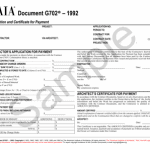
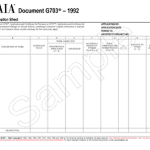
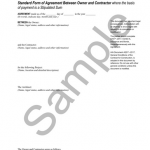
The G702® – Application and Certificate for Payment and G703® – Continuation Sheet are the industry standard for monthly payment releases. These forms tie directly to your A101® – Agreement Between Owner and Contractor and flow down to your A401™ – Agreement Between Contractor and Subcontractor.
Each month builds on the last, creating submissions that are consistent and review-ready for the architect, helping accelerate monthly closeouts. With clean payment documentation, architect feedback decreases, and approvals accelerate, keeping cash flow on schedule. It’s also documentation lenders trust to confirm progress and trigger the release of project funding.
Keep Cash Flow Moving with G702 and G703
As a general contractor, you’re managing more than the work. You’re managing labor, materials, subcontractor payments, and project overhead.
Everything depends on one thing: cash flow predictability.
But payment doesn’t move just because work was completed. It moves when the work is clearly documented, properly calculated, and aligned with the contract.
When that alignment breaks:
- Pay applications get rejected or revised.
- Approvals slow down.
- Subcontractor payments get delayed.
- Financial pressure builds on the job.
How A101, A201, and G702/G703 Work Together
A101 establishes:
- The contract sum
- The payment structure
- The timing of progress payments
A201 defines:
- How payment is reviewed and certified
- The conditions that must be met before payment is approved
But neither one executes the payment process. That happens through G702 and G703. They translate contract terms into a working payment system, connecting directly to:
- Schedule of values
- Percentage of completion
- Stored materials
- Retainage
- Change orders
This creates a structured, reviewable process aligned with the contract, and an industry-standard format that replaces guesswork with consistency.
Why G702 and G703 Outperform Custom Pay Apps
There’s a reason AIA form G702 and AIA Form G703 are widely used across the industry. They provide a format that architects recognize, owners expect, and lenders trust.
When a pay application is submitted using this structure:
- It’s easier for the architect to review.
- It’s easier to verify information if disputes arise.
- It’s more likely to move payments forward without friction.
From a GC perspective, that matters. You’re not just submitting numbers; you’re presenting a clear, contract-aligned record of progress.
Coordinate Subcontractor Billing with G702 and G703
General Contractors consolidate dozens of inputs, and each month requires coordination across subcontractors and suppliers. You’re bringing together:
- Subcontractor pay applications
- Supplier invoices and material tracking
- Lien waivers and supporting documentation
- Stored materials and delivery status
All of it must be tied back to the same schedule of values, reflect accurate progress, and meet certification requirements. If even one piece is off, the impact to funding is immediate.
When subcontractors and suppliers are working from the same expectations, everything rolls up cleanly. Documentation supports the full request, reviews move faster, and payments are released with fewer revisions.
From the GC’s perspective, this is more than just administration. It’s coordination at scale, where consistency across every contributor determines how quickly the project gets funded.
What Happens When Payment Documentation Isn’t Consistent
Consistency creates speed. Without a consistent, contract-aligned payment process:
- Pay applications vary from month to month.
- Manual errors creep into calculations.
- Change orders aren’t reflected clearly.
- Architects spend more time reviewing.
- Payments get delayed.
Build a Consistent Payment Workflow with G702 and G703
The most efficient general contractors don’t rebuild their pay applications every month. They build a system once and carry it forward.
- The schedule of values is established upfront.
- Each month builds on the previous one.
- Values roll forward consistently.
- Documentation stays aligned with the contract.
Treat your first pay application as the template for every one that follows. The result is less rework, smoother certification, and efficient funding.
Pressure-Test Your Payment Process
- Are you using a consistent format like G702 and G703 each month?
- Is your schedule of values aligned with your A101 contract sum?
- Are retainage calculations applied correctly and consistently?
- Are change orders incorporated clearly into your pay applications?
The GCs who are best at protecting their cash flow document progress in a way that aligns with the contract, builds trust with reviewers, and keeps payment moving without friction.
Build a Scalable Payment System with G702 and G703
With an Unlimited Subscription to AIA Contract Documents, you’ll have access to G702, G703, A101, A401, and every coordinated agreement you need for your next project.
In the Catina platform, G702 and G703 are available as fillable forms that roll values forward each month automatically. No manual rebuilding, no formatting from scratch, and everything you need to keep your projects on track.