
Guide

Subcontractor’s Guide to Contracts: How To Protect Your Scope, Cash Flow, and Risk

Table of Contents

Subcontractor contracts guideWhat Every Subcontractor Needs to Know About Contracts

Subcontractors are one of the most diverse and specialized groups in the construction industry. Whether your work involves concrete, electrical, framing, plumbing, HVAC, roofing, steel, finishes, or specialty systems, your role is critical to keeping projects moving from planning through closeout.

Unlike owners, architects, or general contractors, subcontractors operate within a unique contractual structure. Your work takes place on the owner’s property, but your agreement is typically with the general contractor, not the owner. In some cases, subcontractors may also manage lower-tier subcontractors or suppliers beneath them, creating additional layers of coordination and responsibility.

That structure makes contracts especially important. Your agreement defines how your scope connects to the broader project, how communication flows, how changes are handled, and how payment moves through the construction chain. Because subcontractors work alongside multiple trades in interconnected schedules, even small gaps in contract clarity can create delays, disputes, or unexpected costs.

AIA contracts support this complex environment by creating consistent expectations across the project team. More than 200,000 projects each year leverage AIA Contract Documents, and the average project includes multiple subcontractor agreements. These industry-standard documents support projects of every scale, from large commercial developments to residential construction to building retrofits.

Subcontractors who understand how contracts function within the full project structure are better positioned to protect their scope, maintain cash flow, coordinate effectively with other trades, and reduce unnecessary risk.

This guide helps you do just that.

Key Takeaways

  • Clear scope definitions protect your margin and reduce rework.
  • Standardized subcontractor contracts improve alignment across the project team.
  • Payment improves when documentation matches contract requirements.
  • Flow-down provisions impact your risk and liability on a job.
  • Consistently documenting changes helps prevent lost revenue.

Section 1: AIA Contracts Overview

Subcontractor’s guide to contracts: how to protect your scope, cash flow, and risk 1

Key AIA Documents for Subcontractors

Most construction contracts are comprised of several coordinated documents that work together as a single agreement. These typically include:

  • The agreement itself
  • General conditions
  • Drawings and specifications
  • Addenda and modifications

Together, these documents define the full scope of the project, not just what is written in your subcontract.

For subcontractors, that means your obligations may be defined across multiple documents and not just one.

The Subcontractor AIA Contract System
Subcontractor’s guide to contracts: how to protect your scope, cash flow, and risk 2
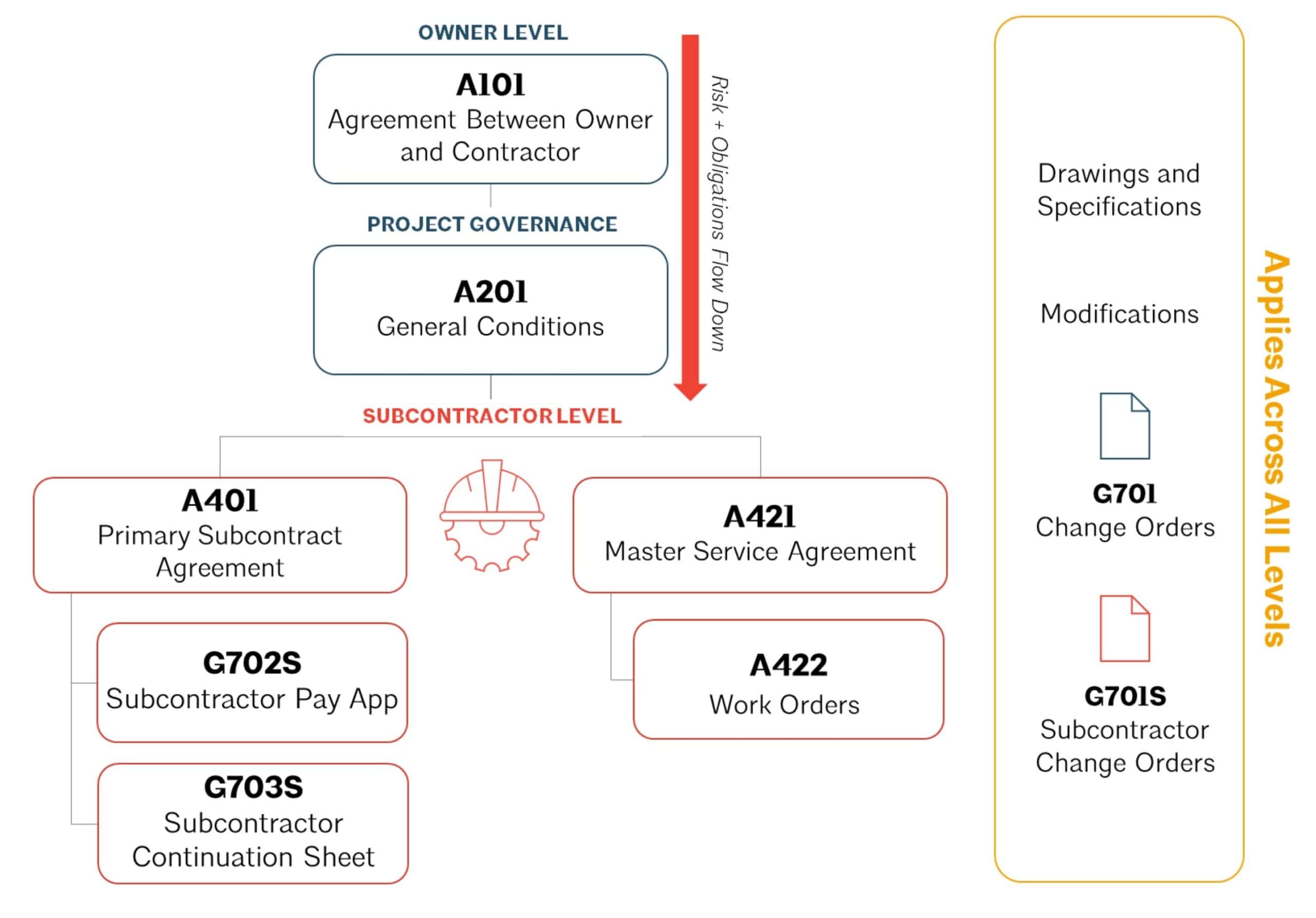
Visual of the coordinating AIA contracts used by subcontractors throughout a project.

A401: Your Direct Subcontract Agreement

Your primary agreement is A401™ – Agreement Between Contractor and Subcontractor, which defines your direct relationship with the contractor.

This document outlines:

  • Your scope of work
  • Payment terms
  • Schedule expectations
  • Change order requirements

It is the document you negotiate most directly, but it is not the only document that governs your work.

A201: How General Conditions Affect Subcontractors

The A201® – General Conditions of the Contract for Construction acts as the foundation for how the project is administered. This coordination is important because it aligns expectations across the contractor, owner, and subcontractors.

It defines:

  • Roles and responsibilities across the project team
  • How changes are handled
  • How disputes are resolved
  • How payment is processed

Even though you do not sign the A201 directly, it often applies to your work through flow-down provisions.

How Drawings and Specifications Define Subcontractor Scope

Drawings and specifications are part of the contract, not just reference materials.

They define:

  • What is being built
  • Materials and systems required
  • Quality standards

If your scope is tied to these documents, you are responsible for work that is “reasonably inferable” from them, even if not explicitly stated.

How Contract Modifications and Change Orders Affect Your Work

Contracts evolve throughout the project. Modifications can include:

  • Change orders
  • Construction change directives
  • Written amendments

These updates become part of the contract and are binding once issued.

Why Written Change Orders Matter for Subcontractors

Changes are a normal part of construction. They enable clear documentation and disciplined notice, protecting from scope creep, and ensuring you get paid for added work and granted time.

Changes to your work will likely come from written directions from the GC and from modifications to the primary agreement.

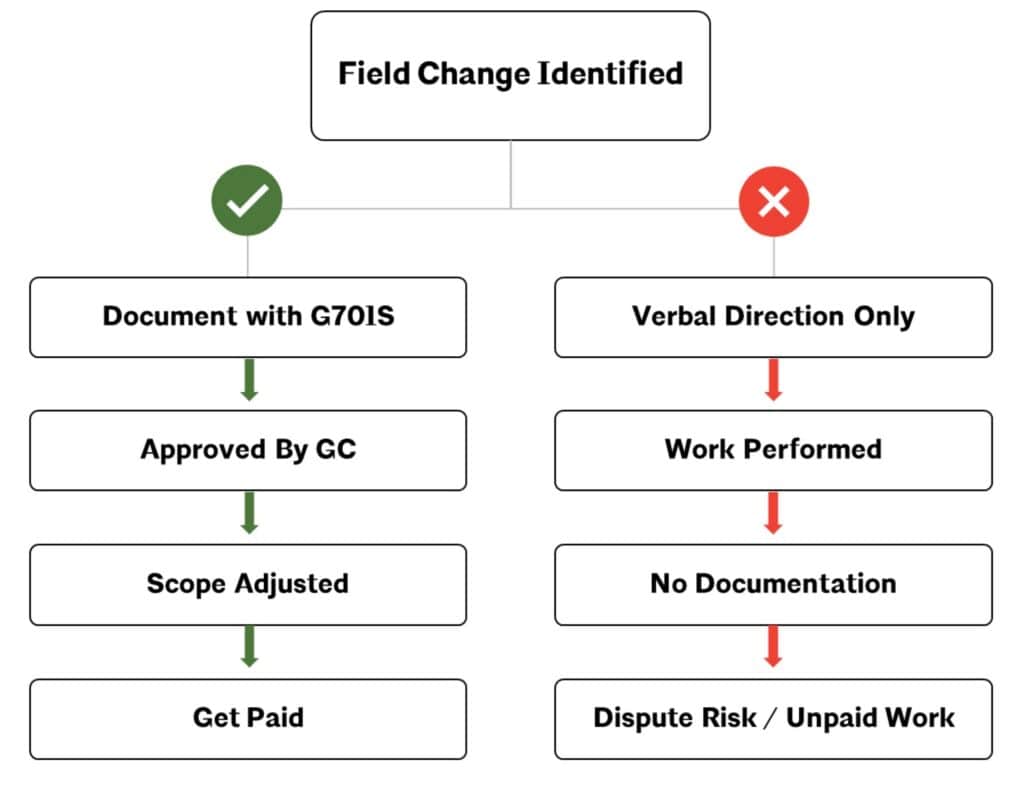
You should not proceed with changing work, ordering materials, or adjusting your scope without written instructions. Without formal change procedures, subcontractors often perform extra work without compensation.


Pro Tip Never perform changes based solely on verbal instruction. Use the G701S Change Order to formally document and implement agreed-upon changes to the subcontract work, including adjustments to price and time.

How To Identify Risk in a Subcontract Agreement

A subcontract should clearly reflect how your work will be performed. When it does not, issues surface during execution.

  • Scope of Work in Subcontractor Contracts: Your scope should define what is included and what is excluded in clear terms. If the scope relies only on drawings or general references, it leaves room for interpretation. That interpretation often leads to disputes.
  • Payment Terms and Conditions for Subcontractors: Payment terms define how and when you get paid. This includes billing schedules, retainage, and required documentation. It is important to understand the flow of payment and know what conditions must be met before approval.
  • Flow-Down Clauses and Subcontractor Risk: Flow-down provisions connect your subcontract to the prime contract. This means you may be responsible for obligations that are not fully described in your agreement. Reviewing these provisions helps you understand your full exposure.
  • Change Order Requirements in Construction Contracts: The change process defines how additional work is approved and paid. If written approval is required, it must be followed consistently.

Why Subcontractors Should Review the Full Contract Set

Understanding the contract anatomy helps you avoid one of the most common issues in construction: relying only on the subcontract language.

In practice:

  • Your scope may be expanded by drawings and specs.
  • Your obligations may be expanded by A201.
  • Your payment may depend on processes defined outside your agreement.

By understanding how these documents work together, you can identify risks early and manage them proactively.

Pro Tip Do not review your subcontract in isolation. Review it alongside the general conditions and referenced documents to understand your full scope and obligations.

How Standardized Contracts Improve Project Consistency

Subcontractor agreements are part of a larger contract structure that defines how the entire project operates.

AIA Contract Documents are designed as a coordinated system that creates consistency across the construction process. When contracts are aligned, project teams spend less time resolving conflicts and more time executing work.

Over 200,000 projects per year leverage AIA Contract Documents, with the average job leveraging five subcontracts. Chances are AIA subcontracts will play an important role in your contracting future.

Understanding how these pieces fit together helps you identify where risk, responsibility, and payment requirements come from.

Section 2: A401 Standard Subcontractor Agreement

Subcontractor’s guide to contracts: how to protect your scope, cash flow, and risk 3

How A401 Works Within the Full Contract Structure

The A401™ – Agreement Between Contractor and Subcontractor is the industry’s trusted standard that defines your direct relationship with the contractor. It was intentionally written to be agnostic, enabling any trade to use it.

The A401 operates within a broader set of documents that defines the entire project:

In practical terms, you are not just agreeing to the A401. You are stepping into an existing contract system that has already allocated risk, responsibilities, insurance obligations, and dispute-resolution rules.

How A401 Helps Manage Flow-Down Risk

Flow-down provisions make subcontractors responsible for many of the same obligations the general contractor has under the main contract with the project owner. They extend key contract terms, such as scope of work, schedules, payment terms, change orders, and dispute resolution requirements, to the subcontractor.

That means if the general contractor accepts risk upstream, and your subcontract mirrors that obligation, risk can flow down to you. Likewise, upstream limits on the general contractor’s recovery may limit your ability to recover downstream.

Pro Tip You have the right to request copies of the primary agreement and all incorporated subcontract documents. Reviewing them gives you a full understanding of how upstream decisions affect your business.

5 Ways A401 Helps Protect Subcontractors

  1. Clear Scope Boundaries: On a construction site, there are many cooks in the kitchen. Trade capabilities can overlap, so it’s critical to define your boundaries clearly to prevent responsibility creep. Unclear contracts can also lead to cashflow issues, including back charges and margin erosion.
  2. Schedule Sequencing and Delay Protection: Construction schedules are interconnected. When one trade is delayed, others are impacted. Your agreement defines when your work begins, when it must be complete, and how delays are addressed, protecting both productivity and profitability.
  3. Payment Terms and Cash Flow Predictability: Your subcontract establishes payment timing, retainage, and conditions for release of funds. Clear payment terms support steady cash flow and reduce financial surprises.
  4. Jobsite Safety Responsibilities: The GC oversees overall site safety, while you control the safe execution of your work. Understanding this division clarifies liability, insurance obligations, and indemnity boundaries, helping you protect your team.
  5. Contract Risk Alignment: The agreement establishes an order of precedence. If provisions conflict, the subcontract governs the incorporated documents as they relate to your specific work. This hierarchy reduces ambiguity and limits unexpected exposure.

Subcontractor Scope of Work Under A401

The A401 is agnostic to specific trades and provides a section to detail clear lines of responsibility. Your role is to provide specialized construction services or skilled labor under your appropriate licenses.

Article 8 of A401 defines your exact scope of work, including all labor, materials, equipment, and services required. It details which drawings and BIM versions guide decision-making.

Subcontractor Work Requirements

Function

Subcontractor’s Role

Managing Communication With Your Team

The GC will communicate directly with you or your authorized representatives. However, if you bring a crew to the job, communication with your team flows through you. This structure creates a clear boundary of authority and reduces confusion in the field.

Submittal Requirements for Subcontractors

You’ll review and submit shop drawings, product data, and samples. By submitting, you confirm how your portion of the work will be constructed and that your materials and project details align with the contract requirements.

Progress Updates and Work Evaluation


To keep the project in sync, you must provide periodic updates on your work and material status. This allows the GC to track performance against the entire project’s schedule. All work is subject to review by the contractor and architect for compliance with the contract documents.

Coordination With Other Trades

Your work is part of a larger team effort. This may include participating in coordinated drawings to manage the flow of work in tight or complex areas. Communicating early with fellow trades helps align systems and keep the project moving smoothly.

Legal and Code Compliance

You are responsible for securing the required permits and following applicable laws and codes for your scope. This ensures your work moves forward smoothly and meets all regulatory standards. 

Delegated Design Responsibilities

If your work includes delegated design or certified systems, the contractor will provide you with the performance requirements set by the owner and architect, so you know exactly which standards your work must meet. Rely on those requirements when preparing your project documents. Design work must be certified by a properly licensed professional, ensuring your work fits properly with the overall project design.

Pro Tip Accurate and timely submittals protect your scope, which prevents rework and reduces the risk of being held responsible for conflicts in the field.

Other Key A401 Subcontract Provisions

Provision

What It Means

Project Information and Upstream Agreements

The contract will identify the owner, project, and architectural firm details. Contracts also reference the upstream agreements that affect your work.

General Contractor Responsibilities Under A401

The GC manages the full collection of trades to successfully construct the project. This includes overseeing the schedule, jobsite safety, work quality, and payment administration. The GC also serves as a liaison between the owner, architect, and trade peers.

Jobsite Safety and Hazardous Materials

The contract establishes shared accountability for maintaining a safe job site and requires all parties to comply with applicable safety laws and project standards. It also provides clear procedures for handling hazardous materials, including notice requirements, the ability to stop work in unsafe areas, and adjustments to time and cost when conditions are outside your control.

Equipment, Materials, and Jobsite Access 

The contract addresses practical needs, such as jobsite access, temporary utilities, and space to store your materials and equipment.

Warranty Requirements for Subcontractors

You guarantee that your work and materials will meet the contract requirements and be free of defects, except for normal wear or misuse. Upon completion, manufacturer warranties will be properly issued or transferred to the owner.

General Contractor Claims and Back Charges

If the GC claims costs due to your fault, they must provide notice and documentation. If you do not correct a valid issue upon notice, the general contractor may remedy it and deduct reasonable costs from your payments.

Subcontractor Indemnification Obligations

You are responsible for covering certain claims or damages if they are caused by your work or the actions of those working under you.  

Waiver of Consequential Damages

This key provision limits your risk exposure to indirect losses such as lost profits or business interruption claims. However, liquidated damages may still apply.

Schedule Requirements and Order of Work

Time is of the essence in subcontracts, and construction schedules are interdependent. A late predecessor can disrupt your crew and erode productivity, impacting other commitments down the line.

“If you don’t have a baseline schedule, and later on something outside of your control happens that delays or disrupts your work, you’ll have nothing to base any claim on about how those delays are costing you additional dollars that should be paid.” Truax Law 

Your A401 subcontract clearly defines:

  • The date of commencement
  • The subcontract time for substantial completion
  • Milestones for any phased or partial completion
  • The process for requesting time extensions

Knowing exactly when your portion of the work begins and when it must be completed is critical.

Section 3: Using Subcontractor Agreements

Subcontractor’s guide to contracts: how to protect your scope, cash flow, and risk 4

When To Use Different Subcontractor Documents

Design-Bid-Build Subcontract Agreement: A401

Design-bid-build project agreements, such as A401, are used when your scope is tied to a specific job. These agreements define all terms within that project and require careful review each time.

Master Subcontract Agreements for Repeat Work: A421 and A422

For subcontractors working repeatedly with the same contractor, A421™ – Master Agreement Between Contractor and Subcontractor Under Multiple Work Orders can streamline the process.

Instead of renegotiating terms for every project, the master agreement sets consistent expectations, and A422™ – Work Order defines the scope for each job. This approach reduces administrative effort and improves consistency across projects.

Pay Apps for Subcontractors: G702S and G703S

Subcontractors use specific payment application forms designed to align with the contractor-subcontractor relationship and the broader project payment process. The standard forms are G702S™ – Subcontractor Application and Certificate for Payment, and G703S® – Subcontractor Continuation Sheet.

These documents help subcontractors formally bill for completed work, stored materials, and approved changes throughout the project lifecycle. The G702S summarizes the total payment request, retainage, previous payments, and current amount due, while the G703S provides the detailed schedule of values that breaks down progress by line item.

Together, these forms create a standardized workflow that aligns subcontractor billing with the general contractor’s upstream payment application process. Using the correct subcontractor-specific pay apps improves documentation consistency, supports faster review and approval, and helps reduce disputes related to billing and payment timing.

Subcontracting on Design-Build Projects: A441

If you are working directly for a design-builder instead of a general contractor, the contract structure and risk allocation change. In that situation, the appropriate AIA agreement is A441™ – Agreement Between Contractor and Subcontractor for a Design-Build Project.  

Complementary documents include the G742S™ – Subcontractor Application and Certificate for Payment for  Design-Build, and G743S™ – Subcontractor Continuation Sheet for Design-Build. This ensures the payment process matches the design-build structure.

Using A441 and A141 for Design-Build Subcontracts

What makes A441 different from A401 is that your subcontract is directly tied to the design-build agreement. This means your claims, dispute resolution, and timing requirements flow from that prime contract, A141™ – Agreement Between Owner and Design-Builder.

Delegated Design Responsibilities in Design-Build

This delivery method places greater emphasis on delegated design responsibilities, including:

  • Signed and sealed instruments of service when design services are required
  • Professional liability coverage
  • The design-builder’s right to rely on your design work

Managing Subcontractor Risk on Design-Build Projects

Subcontractors should expect earlier involvement in design coordination, closer integration with the design team, potentially broader indemnification exposure, and modified change procedures tied to the prime agreement.

Because risk can shift significantly in a design-build setting, it is critical to carefully review the specific contract language and ensure your lower-tier agreements, insurance coverage, and internal processes are aligned with the design-build framework.

How Change Orders Help Manage Scope Creep

Scope creep often develops gradually through small adjustments and field direction. Without clear documentation, these changes accumulate and impact profitability.

Formal documentation using G701S™ – Subcontractor Change Order provides a structured way to track changes. It connects additional work to cost and schedule adjustments, ensuring changes are recognized and compensated.

How Change Orders Protect Subcontractor Scope and Payment
Subcontractor’s guide to contracts: how to protect your scope, cash flow, and risk 5
Visual comparison of using a process for managing change vs. informal processes and the results.
Pro Tip If it is not documented, it is difficult to bill. Treat every change as part of your contract workflow, not an exception.

Section 4: Contract Value + Payment Rights

Subcontractor’s guide to contracts: how to protect your scope, cash flow, and risk 6

How To Define the Subcontract Value

The subcontract is where you define the value of your work and build protection against unclear or dynamic costs.

Built-in pricing tools help manage variables:

  • Alternates address potential changes in material selection.
  • Unit prices cover work measured by quantity.
  • Allowances provide flexibility where final selections have not yet been made.

When clearly defined, these mechanisms protect your margin while keeping the project adaptable.

The total sum is agreed upon at signing, but it may be adjusted as permitted under a G701S™ – Subcontractor Change Order.

Subcontractor Payment Rights and Cash Flow Protection

Understanding payment application timelines and documentation requirements strengthens your financial stability.

How Subcontractor Payments Flow Through the Project
Subcontractor’s guide to contracts: how to protect your scope, cash flow, and risk 7
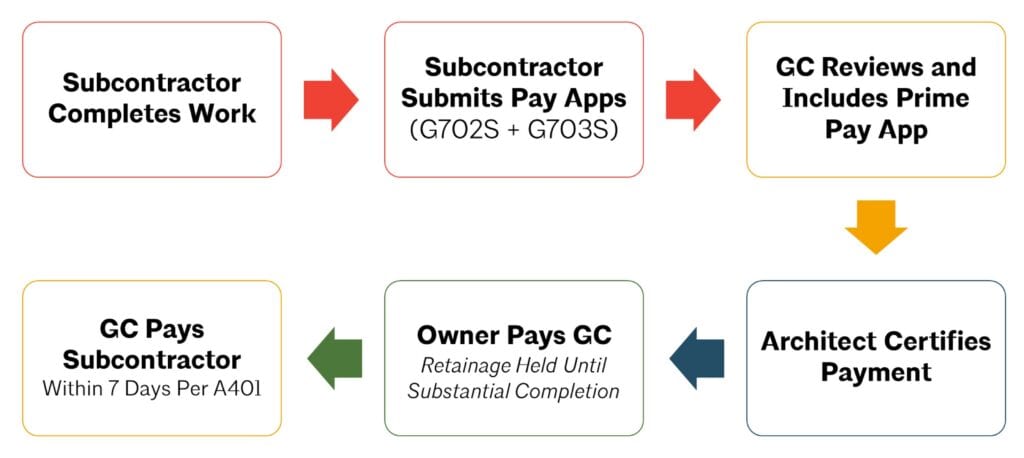
Visual representation of the process through which subcontractors submit pay apps and receive payment.

Progress Payment Requirements

Progress payments are your project’s cash flow lifeline. You must submit a monthly G702S™ – Subcontractor Application and Certificate for Payment  with a complimentary G703S® – Subcontractor Continuation Sheet. These pay apps capture the percentage of work completed and the approved use of materials and equipment during the month.

Timely and accurate submission of these forms, along with the required lien waivers, is essential to keep payments moving.

Retainage and Substantial Completion

Retainage protects owners by withholding a portion of payment until work is complete. Specific retained percentages, exclusions, and any early reductions are subject to applicable law. Adhering to the designated quality of work is also critical for payments. Your monthly payment may be reduced for uncorrected work or contractually permitted withholdings.

Once your work is substantially complete and final lien waivers are submitted, you are entitled to receive the remaining balance of your subcontract, including retainage.

Subcontractors’ Payment Responsibilities

You are responsible for paying your labor, supplier, and equipment costs as payments are received, and you must provide proof of payment upon request by the general contractor.

How Payment Timing is Governed

Pay-When-Paid Clauses

A pay-when-paid clause governs the timing of payments. As a subcontractor, your payment is tied to the GC first receiving payment from the owner upon the architect’s certification of payment.

Under the A401, the GC must pay you within seven days of receiving payment from the owner. You can leverage interest to discourage payment delays.

If the GC fails to secure progress payments from the owner or doesn’t have strong cash management processes, this can have a ripple effect on your ability to get paid. 

Subcontractor Rights When Payment is Delayed

As a subcontractor, you have non-payment rights you can exercise upon giving notice.

This includes stopping work and recovery of reasonable costs for demobilization, delays, and remobilization once payment is received. If the non-payment issue is indefinite, these rights provide legal protection.


Pro Tip If payment is late, follow the notice procedures precisely before stopping work. This discipline protects your leverage.

Protection Through Insurance and Bonding

A401 defines how insurance and bonding protect both your business and the project.

Required Insurance Policies for Subcontractors

The contract includes a table that outlines the required insurance types, limits, and conditions you are expected to carry.

Policies must cover the duration of your engagement, including applicable correction-of-work periods. Certificates of Insurance must be shared with the GC and the owner.

Your policies must include additional insured status for related project parties, including the general contractor, owner, architect, and consultants, to cover any claims of negligence. The agreement also addresses waivers of subrogation, limiting lawsuits among project participants for insured losses.

Coverage Under Owner and Contractor Policies

You have rights to coverage under the owner’s and GC’s policies as an additional insured and may request to review their Certificates of Insurance. The owner is responsible for maintaining the overall property insurance covering the value of the project.

Payment and Performance Bond Requirements

If required, you may also need to provide payment and performance bonds. These bonds offer financial assurance that your work will be completed and that lower-tier parties will be paid. 

They are issued using A312™ – Payment Bond and A312™ – Performance Bond.

Protecting Your Rights If Project Disputes Arise

Even well-run projects can have issues. How your subcontract handles disputes determines whether those issues become manageable business events or costly disruptions.  

Subcontractor Dispute Resolution Process

Claims must first go through mediation. This structured step encourages resolution early and helps control legal costs. If unresolved, disputes move to the selected binding method, which is either arbitration or litigation.

Consolidation and Joinder in Disputes

Related disputes may involve other parties or contracts, such as the owner, another subcontractor, or a design professional. Consolidation combines related arbitration proceedings into one, while joinder allows additional parties to be brought into an existing proceeding. Either approach can help resolve interconnected disputes more efficiently and reduce legal costs.

Subcontractor Termination Rights

You may terminate your agreement for extended nonpayment or under-breached conditions. If termination occurs through no fault of your own, you are entitled to payment for completed work and reasonable costs incurred.

Contractor Termination for Cause

If the breach is your fault, such as if performance deficiencies are not corrected after notice, the GC may terminate your agreement. If they proceed to complete your work, your payments may be offset against unpaid balances.

Suspension For Convenience 

If the GC pauses work, you are entitled to equitable adjustments for time and cost impacts.

Assignment of the Subcontract 

If the owner terminates the GC for cause, your subcontract may transfer directly to the owner.

Under A201, the owner may assign your subcontract to a new GC, but the owner remains responsible for ensuring your contractual obligations are honored.

Section 5: Improving Project Coordination

Subcontractor’s guide to contracts: how to protect your scope, cash flow, and risk 8

How Better Contracts Improve Project Coordination

Coordination is critical because each trade depends on others. Contracts establish how communication, sequencing, and responsibilities are handled.

When these elements are clearly defined, coordination improves, and issues can be addressed early. When they are unclear, subcontractors often face delays or conflicts that impact productivity.

Take Control of Your Contracts From Start to Closeout

Managing subcontractor agreements isn’t just about what’s written; it’s about how consistently those terms are executed across every project.

A contract management system provides a centralized platform for visibility into current documents and workflows. It allows teams to track updates, manage approvals, and maintain consistency across projects.

With AIA Contract Documents’ Unlimited Access, your team can generate AIA contracts, track change orders, manage pay applications, and maintain complete visibility into contract workflows, all in one place.

Build Smarter With Aligned Subcontractor Contracts

Subcontractor contracts define how work is executed and how results are achieved. When contracts are clear and aligned with project conditions, you can focus on delivering work instead of resolving disputes.

Using standardized agreements, maintaining consistent documentation, and aligning with the project team will help you reduce risk and improve outcomes. These practices support better coordination, stronger cash flow, and more predictable project performance.

Build smart by starting with contracts that reflect how work is actually done.

Frequently Asked Questions

Subcontractor’s guide to contracts: how to protect your scope, cash flow, and risk 9

Subcontractor Contract FAQs 

What is the purpose of a subcontractor contract in construction?

A subcontractor contract defines the scope of work, payment terms, schedule expectations, and responsibilities between the contractor and subcontractor. It creates a clear framework for how work is performed and how issues are resolved.

What is A401 and when should subcontractors use it?

A401 is the standard agreement between contractor and subcontractor. It is used when defining scope, payment, and responsibilities on a specific project. It is widely adopted and aligns with other AIA Contract Documents.

How do flow-down clauses affect subcontractors?

Flow-down clauses tie your subcontract to the prime contract. This means you may be responsible for meeting requirements set at the owner or contractor level. These clauses can impact schedule, documentation, and performance obligations.

Why do subcontractors experience payment delays?

Payment delays often occur due to incomplete documentation, mismatched billing formats, or approval process issues. Aligning your pay applications with contract requirements helps reduce delays.

How can subcontractors manage change orders effectively?

Use a consistent process to document all changes before performing the work. Standard forms like G701S help connect changes to cost and schedule adjustments.

What are the benefits of using AIA Contract Documents?

AIA Contract Documents are widely adopted, regularly updated, and designed to reflect real project conditions. They help reduce ambiguity, improve coordination, and support consistent workflows.

How can subcontractors reduce risk in contracts?

Review scope carefully, understand flow-down provisions, align documentation with contract requirements, and use standardized agreements to reduce ambiguity.