
Comparing AIA Contracts: B-Series, C-Series, and G-Series
Architecture projects rely on a coordinated set of agreements and forms. Instead of drafting new contracts for each project, many firms use standardized document families bearing the official AIA seal that define responsibilities across the project lifecycle.
These documents are organized into series based on the relationship they govern. The three most common series architects work with are:
- B-Series — Owner–Architect Agreements
- C-Series — Architect–Consultant Agreements
- G-Series — Contract Administration Forms
Together, these documents align responsibilities between architects, owners, consultants, and contractors. 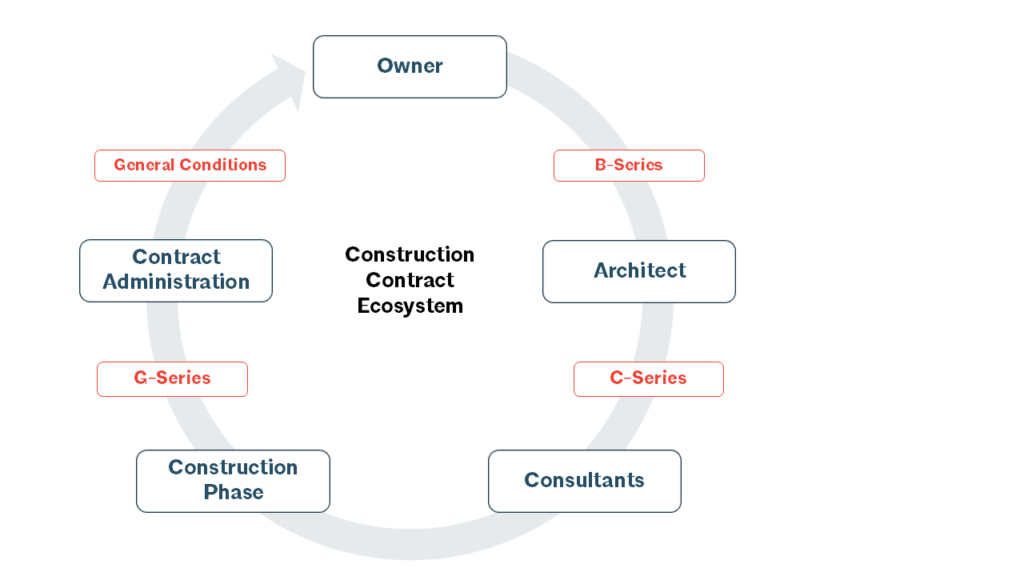
B-Series: Owner–Architect Agreements
The B-Series forms the foundation of the architect’s role on a project. The B-Series defines the contractual relationship between the architect and the project owner.
These agreements set up the following:
- Scope of architectural services
- Project phases
- Compensation structure
- Responsibilities during construction
- Dispute resolution process
Common B-Series Agreements
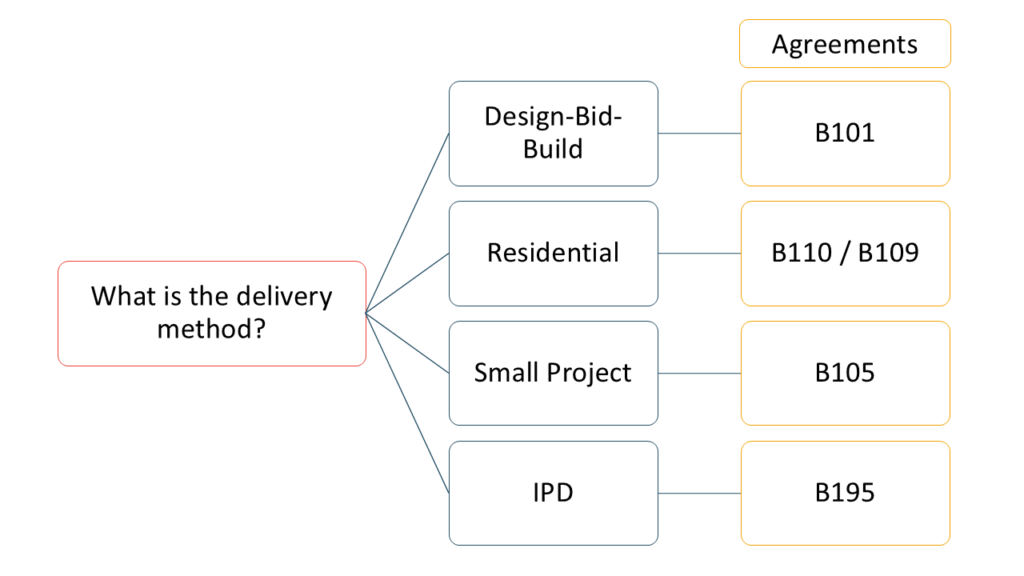
- B101™ – Agreement Between Owner and Architect: The most widely used architecture agreement, it’s ideal for design-bid-build projects and medium-to-large developments.
- B104™ – Abbreviated Agreement Between Owner and Architect: Used when architectural services are smaller in scope but still require a formal agreement.
- B105™ – Short Agreement Between Owner and Architect: Simplified agreement for small projects with limited services.
- B109™ – Agreement Between Owner and Architect for a Multi-Family Residential or Mixed-Use Residential Project: Designed for mixed-use/multi-family residential projects.
- B110™ – Agreement Between Owner and Architect for a Custom Residential Project: Tailored for custom homes.
- B121™ – Master Agreement Between Owner and Architect for Services Under Multiple Service Orders: Used when architects work repeatedly with the same client. Individual projects are started through service orders.
- B132™ – Agreement Between Owner and Architect Construction Manager as Advisor (CMa): Used when the project includes Construction Manager as Advisor (CMa).
- B133™ – Agreement Between Owner and Architect Construction Manager as Constructor (CMc): Used when the project includes Construction Manager as Constructor (CMc).
- B195 – Owner-Architect Agreement for Integrated Project Delivery: Designed for collaborative project teams where responsibilities are shared.
How To Choose AIA Contracts by Delivery Method
C-Series: Architect–Consultant Agreements
The C-Series defines the relationship between the architect and these consultants. Architects often hire consultants to support specialized aspects of the design. Common consultants include:
- Structural engineers
- Mechanical and electrical engineers
- Civil engineers
- Landscape architects
- Interior designers
- Sustainability consultants
Most Common Consultant Agreement: C401
C401™ – Agreement Between Architect and Consultant: Aligns the consultant’s responsibilities with the architect’s obligations under the owner-architect agreement. This agreement ensures:
- Consistent scope definitions
- Coordinated responsibilities
- Aligned insurance requirements
- Consistent dispute procedures
G-Series: Construction Administration Forms
Once construction begins, architects rely on administrative forms to document project decisions and progress. These forms create a consistent record of:
- Work completed
- Changes to the project
- Contractor payment requests
- Project completion milestones
Common G-Series Forms
- G701™ – Change Order: Documented and approved changes to scope, cost, or schedule.
- G702® – Application and Certificate for Payment: Used by contractors to request payment and by architects to certify work progress.
- G703® – Continuation Sheet: Provides a detailed breakdown of the contractor’s work completed and remaining.
- G704™ – Certificate of Substantial Completion: Marks the point when the project is substantially complete for the owner to occupy the building.
G-Series Forms Across the Construction Timeline
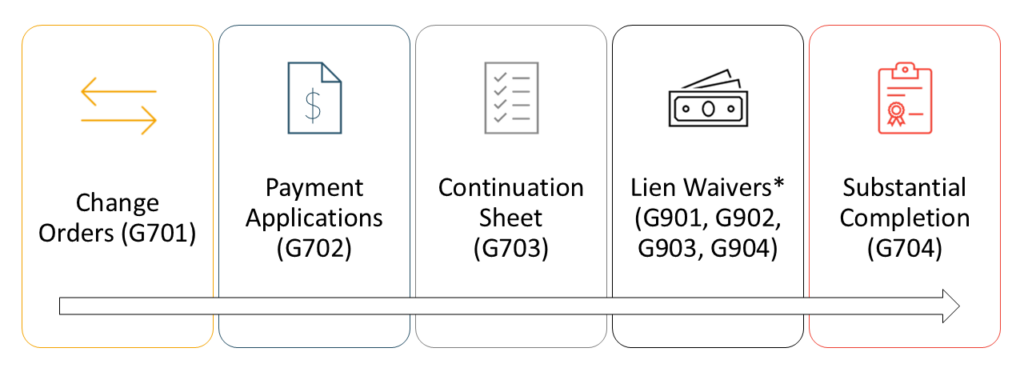
*Some states require state-specific lien waivers.
Here are the generic lien waivers:
- G901™-2022, Conditional Waiver and Release on Progress Payment
- G902™-2022, Unconditional Waiver and Release on Progress Payment
- G903™-2022, Conditional Waiver and Release on Final Payment
- G904™-2022, Unconditional Waiver and Release on Final Payment
Why Coordinated Contract Suites Matter
Projects run more smoothly when all participants use coordinated agreements. When you align on contract usage:
- Responsibilities stay consistent across the project team.
- Dispute procedures are uniform.
- Payment processes match in all agreements.
- Project administration becomes easier.
It’s important to use agreements from the same contract families publication years to avoid conflicting language. It is also important not to repurpose an old contract, as AIA contract language may change over time.
How Architects Use Contract Suites Across a Project
Architectural contracting typically follows a structured workflow.
- Owner-architect agreement establishes the project framework.
- Consultant agreements coordinate the team.
- Construction administration forms document project progress.
Together, these agreements support the entire lifecycle of a building project.






Streamline Your Contract Workflow
ACD’s cloud-based platform helps architects manage the full contract lifecycle—from drafting and editing to execution and storage.
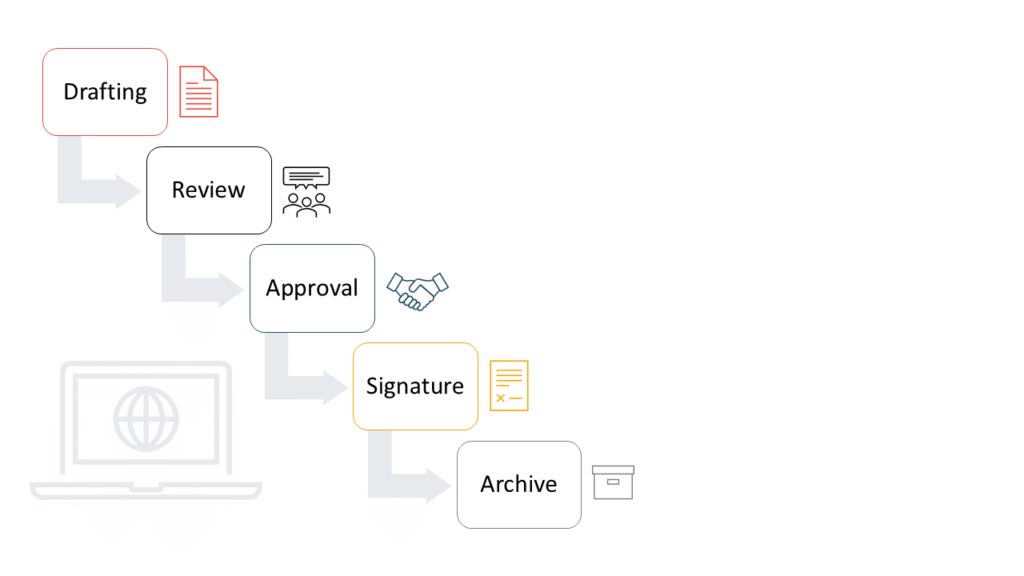
With a centralized system, your team can:
- Work from up-to-date, standardized agreements.
- Collaborate on edits in real-time.
- Track changes and approvals with clarity.
- Store completed documents for easy access across projects and future reference.
Explore how our cloud platform simplifies contract management and supports consistent workflows from project start through completion.

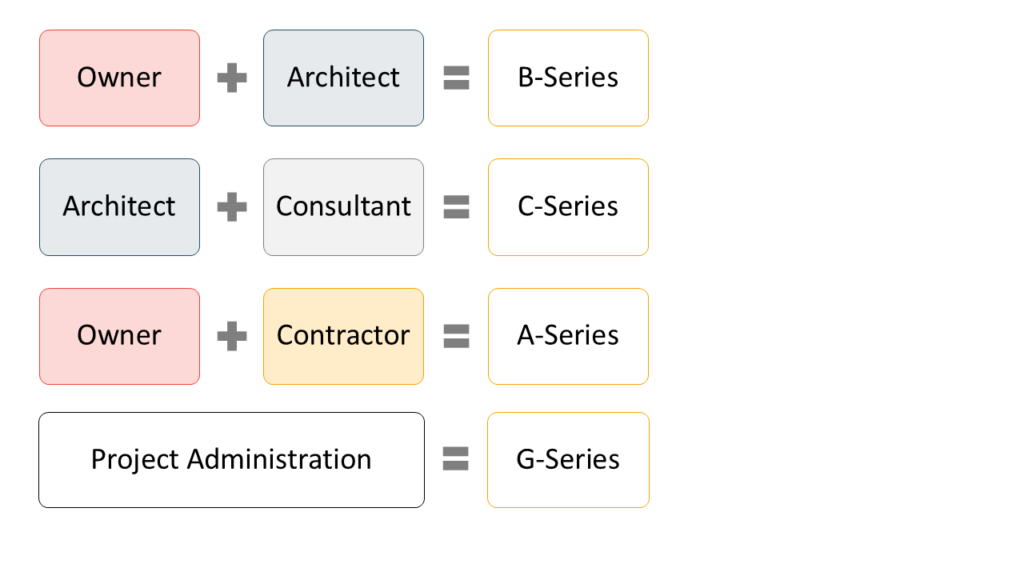
Architects typically use a coordinated suite of agreements and forms that define responsibilities across the project lifecycle. The most common categories include:
- Owner–Architect agreements (B-Series)
- Consultant agreements (C-Series)
- Owner–Contractor agreements (A-Series)
- Contract administration forms (G-Series)
Together, these documents align responsibilities between architects, owners, contractors, and consultants.
Projects run more smoothly when all participants use documents from the same contract family and publication year. This ensures the language and references stay consistent across agreements.
The B101™ – Agreement Between Owner and Architect is the most widely used contract for architecture firms. It is designed for projects using the Design–Bid–Build delivery method.
The agreement shows:
- Architect’s scope of services
- Project phases
- Compensation structure
- Responsibilities during construction
- Dispute resolution procedures
Because B101 is widely recognized across the industry, it often requires fewer modifications during negotiation.
Different B-Series agreements address different project types and delivery models. Common examples include:
- B101™ – Agreement Between Owner and Architect: The most widely used architecture agreement. Designed for Design-Bid-Build projects and medium-to-large developments.
- B104™ – Abbreviated Agreement Between Owner and Architect: Used when architectural services are smaller in scope but still require a formal agreement.
- B105™ – Short Agreement Between Owner and Architect: Simplified agreement for small projects with limited services.
- B109™ – Agreement Between Owner and Architect for a Multi-Family Residential or Mixed-Use Residential Project: Designed for mixed-use/multi-family residential projects.
- B110™ – Agreement Between Owner and Architect for a Custom Residential Project: Tailored for custom homes.
- B121™ – Master Agreement Between Owner and Architect for Services Under Multiple Service Orders: Used when architects work repeatedly with the same client. Individual projects are started through service orders.
- B132™ – Agreement Between Owner and Architect Construction Manager as Advisor (CMa) : Used when the project includes Construction Manager as Advisor (CMa).
- B133™ – Agreement Between Owner and Architect Construction Manager as Constructor (CMc): Used when the project includes Construction Manager as Constructor (CMc).
- B195 – Owner-Architect Agreement for Integrated Project Delivery: Designed for collaborative project teams where responsibilities are shared.
Selecting the correct primary agreement early reduces negotiation time and prevents major revisions once the project begins.
Architects often hire consultants such as:
- Structural engineers
- Mechanical, electrical, and plumbing engineers
- Landscape architects
- Surveyors
- Interior designers
These relationships are typically defined using consultant agreements.
C401™ – Agreement Between Architect and Consultant: The C401 aligns the consultant’s responsibilities with the architect’s obligations under the primary agreement. This ensures consistent scope definitions, coordinated risk allocation, and aligned insurance requirements.
Consultant agreements should mirror the obligations you accepted in the owner-architect agreement.
During construction, architects use a variety of administrative forms to document project progress and decisions. Common examples include:
- G701™ – Change Order: Used to document modifications to the scope of work, cost, or schedule. The owner, contractor, and architect must approve change orders.
- G702® – Application and Certificate for Payment: Used by contractors to request payment and by architects to certify progress.
- G703® – Continuation Sheet: Provides a detailed breakdown of work completed and remaining for payment applications.
- G704™ – Certificate of Substantial Completion: Documents the stage at which the project is sufficiently complete for the owner to occupy or use the building.
Consistent documentation during construction reduces disputes and creates a clear record if issues arise later.
Scope changes are common in construction projects. Formal documentation helps ensure transparency and proper compensation. Common forms include:
- G701™ – Change Order: Document approved adjustments to project scope, schedule, or cost.
- Supplemental Service Agreements: Used when architects perform services outside the original scope of work. Examples include feasibility studies, planning services, interior design, FF&E procurement, and sustainability consulting.
Exhibits help address specialized project requirements. Examples include:
- E204™ – Sustainable Projects Exhibit: Defines sustainability goals and responsibilities, including performance metrics and certification targets such as LEED.
- Digital Data and BIM exhibits: Clarify expectations around digital modeling, file ownership, and software platforms.
Exhibits are the safest way to introduce specialized requirements without rewriting the entire agreement.
The correct forms depend on several factors:
- Project delivery method
- Project size and complexity
- Compensation structure
- Client relationship
- Regulatory or sustainability requirements
Architects often start with a primary Owner–Architect agreement and then add supporting forms that coordinate the entire project team.
Yes. Owners sometimes provide custom contracts rather than industry-standard agreements. These should always be reviewed carefully because they may:
- Expand architect liability
- Require guarantees or warranties
- Shift construction risk to the architect
Architects should review custom contracts with firm leadership and legal counsel before signing.
Always verify whether contract language has been changed. Even minor changes can significantly alter risk allocation.