A handshake is not enough. Construction projects need a real contract to protect cash flow, define roles, allocate risk, and prevent disputes.
A contract does more than document an agreement. It protects your project, clarifies responsibilities, reduces risk, and gives every party a framework for resolving issues when they arise.
For nearly 140 years, the industry has relied on AIA Contract Documents (ACD) to create clear, balanced agreements that help projects move forward with fewer surprises and fewer disputes.
What Is a Construction Contract?
The legal definition is: “A contract is a promise or a set of promises for the breach of which the law gives a remedy, or the performance of which the law in some way recognizes as a duty.”
At its most basic level, every contract includes three essential elements:
- Offer, where one party offers, or “promises,” to do something
- Acceptance, when the other party accepts
- Consideration, where both parties agree on compensation
For example, ABC Construction will build a house for Mr. Smith for the sum of $200,000.
This simple statement includes an offer, acceptance (if both parties sign), and consideration. However, it does not provide enough detail to protect either party if questions, delays, changes, or disputes arise.
That is where a well-written construction contract becomes essential.
What a Construction Contract Should Include
A construction contract should do far more than state the price and scope of a project.
At a minimum, it should define:
- The parties involved
- The contract documents
- Statutory and other requirements
- Scope of work (which is typically defined through drawings and specifications prepared by the design team)
- Responsibilities of each party
- Contract time
- Contract sum
- Payment method and payment processes
- Insurance requirements
- Dispute resolution procedures
- Termination rights and other remedies
- Expectations for how the contractor will interact with the design team, particularly during construction
When these items are clearly documented, project teams can align expectations before work begins rather than trying to resolve disagreements after problems occur.
How Construction Contracts Reduce Risk
Every construction project carries risk. The question is whether that risk is documented, allocated, and understood.
When a contract clearly addresses project responsibilities and procedures, it becomes much easier to resolve issues when they arise.
Sometimes the solution is simple. A party may have forgotten what a requirement is or misunderstood a responsibility. A clear contract provision provides the necessary resolution immediately. Without that guidance, small issues can become expensive disputes.
This is one reason construction risk management starts with the contract itself. The agreement establishes how parties will handle change orders, payment issues, schedule delays, insurance requirements, and other common project challenges.
Using the Contract to Educate Owners
The contract can also be used as an education tool. Many owners, particularly residential clients, have little knowledge of what to expect during construction. In addition, construction terminology that you use every day may be unfamiliar to a first-time owner.
Reviewing the contract together and answering questions helps to set expectations. The more aligned both parties are on the construction process, the less likely it is that there will be misunderstandings and disagreements.
Plus, the better your working relationship is, the more enjoyable it will be to work on the project.
Why Standardized Construction Contracts Matter
Many firms reuse old contracts, simply changing the project name, date, and price. While that approach may seem efficient, it often creates unnecessary risk.
Projects vary in size, complexity, delivery method, and stakeholder requirements. A contract that works for a small residential project may not provide the protections needed for a large commercial project.
Standardized AIA construction contracts help project teams start with agreements that have been developed specifically for the construction industry and refined over decades of use. Best practice is to select the right agreement based on the delivery method and customize the contract only where required.
When To Engage a Lawyer
It’s a good idea to have a knowledgeable attorney review your agreements, especially for more complex projects. There may be local statutory requirements that need to be addressed.
This is particularly true in residential construction within the consumer protection framework, as some jurisdictions have requirements in place to protect homeowners.
The law changes, and laws differ in each jurisdiction, so you need to make sure your contract is current and appropriate for each location.
Why the Industry Uses AIA Contract Documents
The construction industry relies on AIA documents because they provide clear, balanced agreements for virtually every project type.
Rather than forcing project teams to create contracts from scratch, AIA documents provide proven frameworks that address the issues construction professionals encounter every day.
Documents are developed by a committee of practicing architects, contractors, attorneys, and owners who use them in the field. Language is also revised regularly to reflect changes in law and industry practice, and it has been tested in courts across the country.
Common examples include:
- A101® – Agreement Between Owner and Contractor
- A201® – General Conditions of the Contract for Construction
- B101™ – Agreement Between Owner and Architect
- A401™ – Agreement Between Contractor and Subcontractor
Because these forms are widely adopted across the industry, project parties are often already familiar with their structure and terminology. That means less time focusing on standard provisions and more time on project-specific terms.
Choosing the Right AIA Contract for Your Project
AIA Contract Documents are organized by project role and project type. Choosing the right agreement starts with understanding the delivery method and the roles involved.
When selecting a construction contract, consider:
- Project Type: Residential, commercial, institutional, infrastructure, or mixed-use projects may require different agreements.
- Project Delivery Method: Design-bid-build, design-build, CMc, and other delivery methods each require different contractual relationships.
- Project Complexity: Larger projects often require more detailed provisions related to scheduling, coordination, payment, and risk allocation.
- Local Requirements: Many jurisdictions impose statutory requirements that contracts must address. This is especially common in residential construction, where consumer protection laws may apply.
Because laws and regulations change, it is good practice to have qualified legal counsel review agreements periodically to confirm compliance with current requirements.
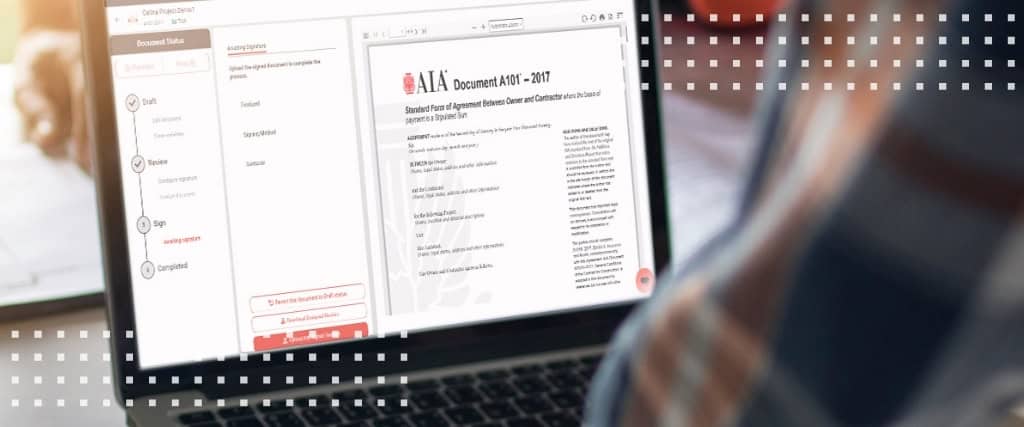
Staying organized and moving quickly on contracts is just as important as the contract itself. The right contract management system keeps your documents and approvals in one place, so nothing falls through the cracks.
Build Smart With AIA Contract Documents
The way you staff a job, structure a bid, handle a change order, and resolve disputes all rely on a strong contract foundation. Whether you are starting a residential renovation or managing a complex commercial project, the right contract helps you clarify expectations, reduce risk, and protect project outcomes.
ACD gives you a proven starting point for every project type, delivery method, and relationship. An unlimited subscription puts the full library at your fingertips, so the right document is always ready when you need it.