Could AI Use Become Part of the Standard?
Could failing to use AI review one day fall below the standard of care? Probably not today or merely because a tool exists.
But professional negligence cases typically use expert testimony to describe how reasonable and prudent practitioners behave. Practice evolves, and the standard can evolve with it. If automated quality assurance becomes fully routine in document production, an expert may one day ask why a firm skipped a widely used check.
The best defense against that argument is also the best protection against overreliance: a documented, deliberate review process that explains which tools your firm uses, what you use them for, and why.
This is the architect-specific issue that deserves more attention. AI may not raise the legal standard today, but it can create a more detailed record of what the firm saw or could have seen. The tool’s output can become evidence. The firm’s documented judgment determines what that evidence means.
AI Review Still Requires Professional Judgment
Automated checks overlap the architect’s work in two places:
- During document production, when the architect’s team runs the tool.
- During construction, when someone else’s findings arrive at the architect’s desk.
When the Architect Uses AI
AIA’s Guidance for the Responsible Use of AI by Architecture and Design Firms states that: “All AI-generated outputs must be reviewed and validated by qualified professionals.”
Four principles follow, no matter how capable the tool becomes.
You Still Sign the Drawings
Licensing and sealed document requirements vary by state and jurisdiction but generally require that they are prepared under the architect’s responsible control or direct supervision.
Ultimately, responsibility follows the licensed professional (not software). Saying “AI missed it” isn’t going to land any better than “the intern missed it.” Lawyers are already learning this the hard way. Courts have sanctioned attorneys for filing briefs with AI-fabricated citations, probably most famously in Mata v. Avianca (S.D.N.Y. 2023). The court in this case was explicit that using an AI tool wasn’t the problem; the problem was failing to verify its output (and then standing by it once questioned). This lesson transfers directly to architects’ practice.
A Tool Is Not a Consultant
Work can be delegated to a qualified consultant who carries a license, a standard of care, and insurance. Software does not. Judgment cannot be delegated to AI products. A clean AI report is not the same as a review by a qualified professional; it provides an input to your review process, not a substitute for it.
The Review Is the Deliverable
The owner is paying for qualified professionals to prepare and review the documents and explain the decisions behind them. AI outputs are drafts and data points.
Speed Is Not a Defense
Faster production does not justify compressed review. In many cases, it should create more time for checking, not less. If a tool returns results in minutes, no one will accept “we didn’t have time to review it” as an excuse.
Two Failure Points Deserve Attention
The obvious failure point is false confidence or treating a clean AI report as proof that the set is actually clean. A tool that runs hundreds of checks is still not exhaustive. It may not understand the design intent, constructability judgment, or the owner’s requirements as a qualified professional would.
The less obvious potential failure point is an unaddressed flag. A place where AI caught something that wasn’t ultimately reviewed and evaluated by a professional. If your AI tool flags a problem and the record shows no one evaluated it, there can be a standard-of-care problem. The flag may become evidence that your firm knew, or should have known, about the issue, but took no action because it wasn’t reviewed.
That doesn’t mean every flag is correct. It’s completely reasonable to reject an AI finding as inaccurate or inapplicable. Just document why. Don’t leave it sitting unresolved in the project file.
When Someone Else Uses AI To Review Drawings
Architects should expect AI-generated findings to arrive through normal construction channels during a construction project. Requests for information (RFIs), submittals, and claims may all be produced or reviewed with AI.
Under the typical A201® – General Conditions of the Contract for Construction structure, the contractor reports errors, inconsistencies, and omissions to the architect “as a request for information,” and the architect reviews and responds. Those responses are professional services measured by the same standard of care that applies to the architect’s drawings.
Firms should address three practical issues before the first automated report arrives.
Control the Volume
Automated reviews can generate far more flags than a human reviewer, and each flag that becomes an RFI still requires a timely, considered response. B101 contemplates an RFI will identify the specific Drawing or Specification needing clarification and describes the clarification requested. A raw export of AI flags may not meet that requirement. Best practice would be to agree early on the submission format, reasonable response timing, and routing process.
Separate Severity From Noise
Given the current state of AI, many flags may be false positives or matters of preference rather than fact. Say so in the response to such an issue and explain why. That reasoning is the professional judgment the project record needs.
Guard Against Scope Creep
A sufficiently large volume of findings can pull an architect into re-reviewing the full set during construction. B101 treats some RFI responses as Additional Services. Check your agreement before the review begins, including how findings must be formatted and created.
Contract Language To Check Before Using AI Review
Most legal issues surrounding the use of or reliance on AI review are not new. These are familiar legal questions with a new fact pattern. AIA documents already provide a structure and vocabulary. Automated drawing review fits into the contract document framework.
Focus on these six areas to get a handle on risk regarding the use of AI review.
Standard of Care
Confirm that the clause still reads as a negligence standard. Push back on amendments that tie the architect’s obligations to everything a tool can catch or promises error-free documents because AI was used. Consider this as marketing material as well. What may be meant as purely marketing speak, i.e., faster, cheaper, or error-free work due to the use of AI, can be determined to be a promise and not just talk.
AI Use and Disclosure Provisions
Owner riders increasingly restrict, condition, or require disclosure of AI-assisted work. Read them literally. A broad ban on “artificial intelligence” may unintentionally sweep in tools your team uses every day. If the agreement requires disclosure, identify who owns that obligation. Even where it is not, AIA’s guidance encourages firms to tell clients when and how they use AI.
Reliance on AI Findings
A short clause can prevent a lot of arguments. Define who may rely on automated review and for what purpose. The parties can agree that:
- Automated reviews are coordination aids
- Findings must follow the normal RFI process
- No one represents the output as complete
- Using the tool does not raise or lower any party’s contractual standard of care or review obligation under the agreement
Vendor Terms
Software license terms commonly disclaim the output accuracy and cap the vendor’s liability at a fraction of fees paid. Reliance may not be passed back or shifted to the AI tool provider, and the project team’s obligations may therefore exceed the vendor’s responsibility. Consider that gap in your process and contract language.
Instruments of Service and Confidentiality
Uploading drawings to a third-party platform may involve the architect’s instruments of service and potentially the owner’s confidential information. The architect retains ownership of its instruments of service; others use them under license. A contractor that uploads the set to a platform whose terms let the vendor retain, or train on, project data may violate that license. Check the vendor terms alongside B101’s confidentiality provisions.
Insurance
Ask your broker directly if and how the professional liability policy addresses AI-assisted work, including any exclusion, endorsement, or silence. Also ask whether the policy covers liability assumed under an elevated standard of care.
Disclaimers can help define what an AI finding means and who may rely on it. However, they cannot relieve a licensed architect of the duty to exercise professional judgment over sealed documents. And courts generally read exculpatory language strictly against the party relying on it. Disclaimers set and define expectations, not to replace a proper review.
A Practical AI Review Playbook for Architects
Before your firm relies on AI-assisted review, ask three questions.
- Would a reasonable and prudent peer use AI for this task on this type of project today?
- Can we show how a qualified person checked the output and resolved each material finding?
- Is the reviewer qualified to catch errors the tool may make, just as they would be without AI assistance?
If the answer to any of these questions is no, the work is not ready to be issued.
Then put the process into practice:
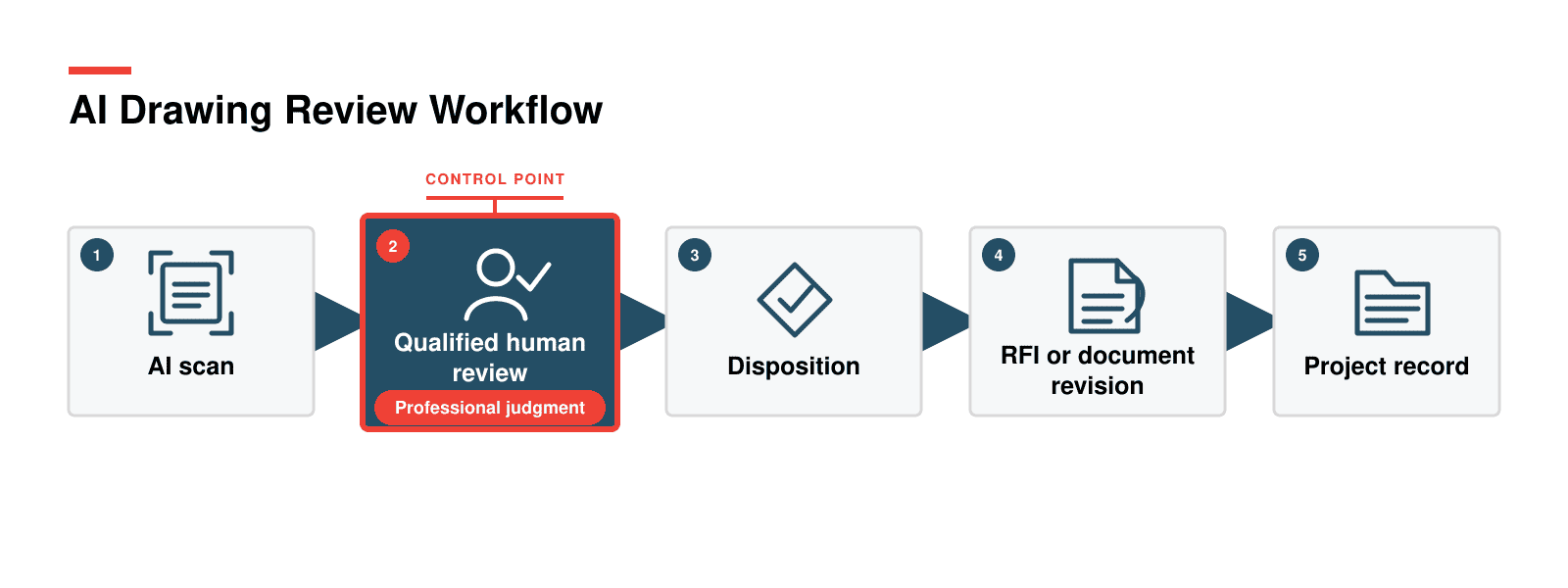
- Treat AI as quality assurance and quality control input, not a substitute. Require a qualified person to review every output before the team relies on it.
- Record every action. Everything flagged by AI review should have a documented disposition, whether the team fixed the issue, rejected the flag with a reason, or referred it to a qualified consultant. Keep the record in the project file, not only in one person’s email or chat history.
- Verify every citation. Check code sections and referenced standards against current sources to ensure they are valid and current.
- Set the construction-phase process early. Define and agree with the owner and contractor on how AI findings will be submitted, validated, and answered during construction, and identify what falls outside Basic Services.
- Review owner amendments. Check the standard of care, disclosure, data, and indemnity language in owner amendments or addendums against the standard agreement before signing.
- Flow expectations down. Make sure consultant agreements address AI use consistently with the prime agreement and the firm’s internal policy.
The Bottom Line
Automated drawing review is a real, genuine, and beneficial advance. Tools that catch conflicts and omissions before they become change orders can help owners, contractors, and architects.
But the tool owns nothing, and the responsibility structure is unchanged. The architect still owns the professional judgment behind sealed documents. A clean report doesn’t prove the set is clean, and a flag doesn’t prove the documents are wrong. What matters is whether a qualified professional evaluated the output, reached a reasoned conclusion, and left a clear record.
The firms that benefit the most from AI won’t be the ones that adopt the most tools or the fewest. They will be the ones that can explain clearly how the use of the tool fits into a process controlled by qualified professionals.
Watch AI in Practice: Where the Real Risk Lies
Catch the replay of my recent webinar discussing practical AI exposure, professional standards, contract provisions, and the controls architecture firms can put in place now.