
What Is a Certified AIA Contract Document? Everything You Need to Know

Professionals across the architecture, engineering, and construction (AEC) industry rely on AIA Contract Documents (ACD) for their court-tested language and consistent structure. At the same time, AIA Contract Documents are designed to be flexible, allowing project teams to modify agreements to address specific project needs.

That flexibility also creates an important question: How do you know the document you’re reviewing is an authentic AIA contract document, and that every change has been disclosed?

For project teams and third parties such as insurers, lenders, and surety bond underwriters, that answer matters. These stakeholders rely on contract language to evaluate risk, yet they often were not involved in negotiating or drafting the agreement.

This is where having a certified AIA Contract Document plays a critical role.

Quick Reference Guide: When Does Certification Matter?

If You Need To…Certification Helps By…
Verify an agreement is an authentic AIA Contract DocumentConfirming the underlying AIA language is genuine
Understand what changed from the standard formDisclosing all additions and deletions
Review contracts for lending, bonding, or insuranceProviding confidence that no undisclosed edits exist
Confirm the final executed versionCertifying the specific finalized agreement

Why Request a Certified AIA Contract Document?

Because AIA Contract Documents are frequently customized, transparency around those changes is essential.

Without certification, a document presented as an “AIA contract” may contain undisclosed revisions or may not be an authentic AIA agreement at all. Certification helps prevent misleading or fraudulent practices while reducing contractual and financial risk.

There are real-world examples that demonstrate why this matters.

Attorney at Law Magazine describes one case where a general contractor copied an AIA subcontract outside of the AIA Contract Documents editing platform and removed key rights typically afforded to subcontractors without disclosing those changes.

Because the document was not a certified AIA Contract Document, those modifications went unnoticed.

Had the document been certified, every contract revision would have been clearly visible, helping protect the subcontractor from undisclosed risk.

Pro Tip Always request the certified version of an AIA Contract Document when reviewing agreements for lending, insurance, bonding, or risk management purposes. Certification makes every modification transparent.

What Is a Certified AIA Contract Document?

Certification is administered through the AIA Contract Documents proprietary editing platform and applies only to governing contract documents.

Once a contract is finalized within the platform, AIA Document D401â„¢, Certification of Document’s Authenticity, is added to the governing document’s addendum.

When an authorized party signs D401, they confirm that:

  • The base AIA contract language is authentic
  • All modifications have been fully disclosed
  • The document accurately reflects what the parties agreed to sign

A signed contract alone does not indicate certification. Always look for AIA Document D401.

By signing D401, the signer legally attests that the document is a certified AIA Contract Document and that all modifications have been fully disclosed.
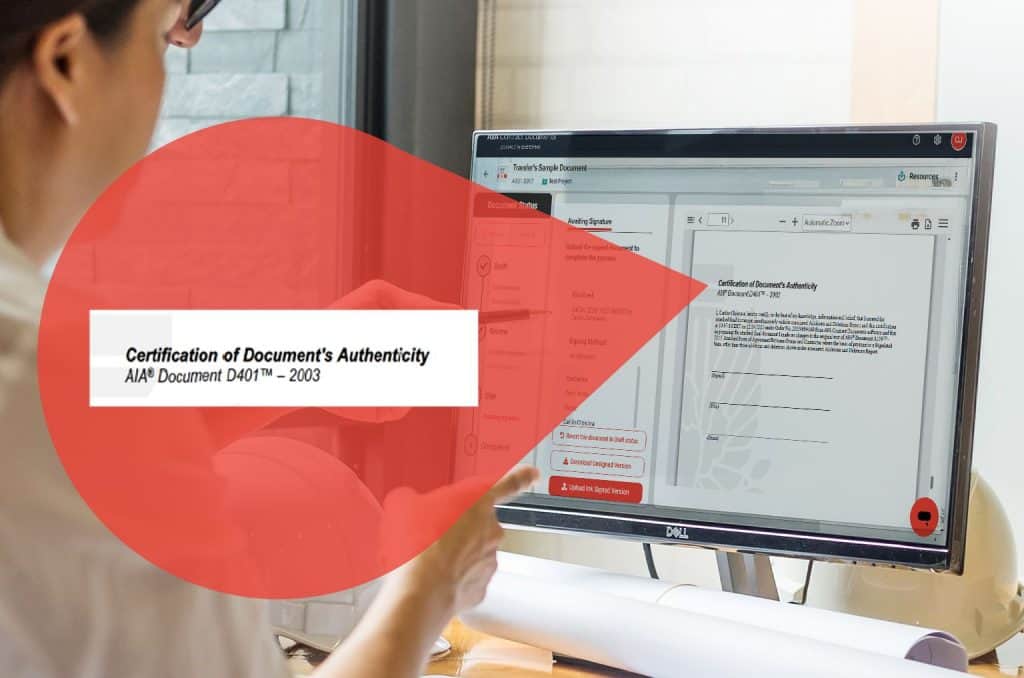
Digital certification of aia contract documents on computer screen.

How to Identify a Certified AIA Contract Document

Once an agreement has been certified, it includes several visual indicators that distinguish it from a draft or non-certified version.

A certified AIA Contract Document includes:

  • The official AIA eagle seal displayed in the document header.
  • An eagle watermark on every page.
  • AIA Document D401, Certification of Document’s Authenticity, included in the addendum.
  • A date and timestamp in the footer showing when the document was produced.

Together, these features allow project teams and third-party stakeholders to verify that the certification process is complete quickly.

Before certification, an AIA Contract Document displays the AIA logo with a red rectangle in the header, and every page is marked with a “Draft” watermark.

After certification, the placeholder is replaced with the official AIA eagle seal, and every page includes the eagle watermark.
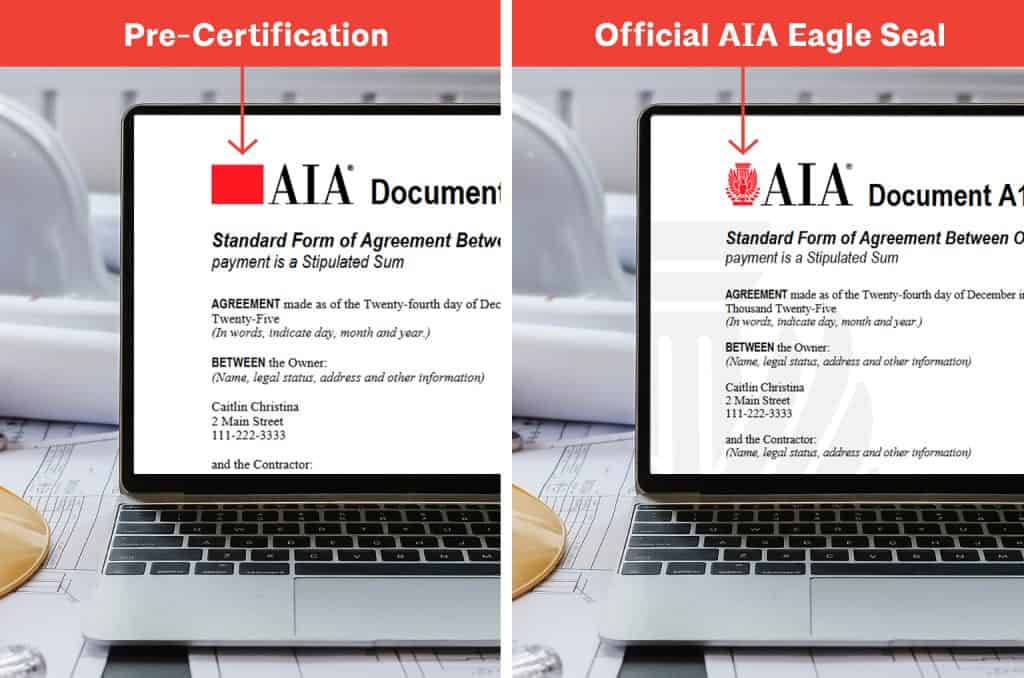
Aia contract document with official aia eagle seal for legal authenticity.

What Certification Does and Does Not Mean

Certification is an important step in verifying the authenticity of an AIA Contract Document, but it is not a legal review of custom contract language.

Certification does not determine whether revisions are advisable or appropriate for a specific project.

Instead, certification confirms that:

  • The AIA base language is authentic
  • All additions and deletions have been fully disclosed
  • The finalized document accurately reflects the agreement signed by the parties

Certification also does not automatically carry forward to future revisions. It applies only to the specific version that was finalized and certified. If the contract is modified after certification, a new finalized and certified version should be created.

Who Benefits from Certification?

Certification provides value to everyone who relies on construction contracts, including:

  • Owners seeking confidence in the agreements governing their projects
  • Architects and engineers protecting the integrity of standard contract language
  • Contractors and subcontractors confirming that changes have been fully disclosed
  • Sureties evaluating bond risk
  • Lenders reviewing project documentation
  • Insurance carriers assessing contractual obligations and risk allocation

For each of these stakeholders, certification increases transparency and reduces uncertainty.

Confidence Through Certification

Certified AIA Contract Documents provide a trusted foundation for construction agreements.

By verifying authenticity and confirming that every modification has been disclosed, certification helps ensure the contract being relied upon is the same one the parties actually agreed to sign.

The result is greater confidence, greater transparency, and greater clarity for project teams and third-party stakeholders evaluating contractual risk.

Create Certified AIA Contract Documents with Confidence

When contracts are created and finalized within the AIA Contract Documents (ACD) platform, certification helps verify authenticity and fully disclose every modification.

Give your project team and third-party reviewers confidence they’re relying on the agreement that was actually negotiated.

Frequently Asked Questions

Does every AIA Contract Document include certification?

No. Certification is available only after a governing contract document has been finalized through the AIA Contract Documents editing platform and AIA Document D401 has been executed.

Is a signed contract automatically certified?

No. A signed contract is not necessarily a certified AIA Contract Document. Look for AIA Document D401, the official eagle seal, eagle watermarks, and the certification timestamp.

Does certification review my negotiated contract language?

No. Certification verifies authenticity and full disclosure of modifications. It does not evaluate whether custom language is legally appropriate or advisable.

Does certification expire?

No. However, Certification applies only to the specific finalized version of the agreement. If the contract changes, a newly finalized and certified version should be produced.

Disclaimer: The information contained in this article is for general informational purposes only, and the views contained herein are the author’s own. It is not legal advice or legal opinion; it does not create any attorney-client relationship; and it may not be used to indicate any intent or to inform any interpretation of ACD’s documents or services, which the AIA Documents Committee separately creates. If you need advice, seek the help of an attorney or other qualified professional who can help you make decisions based on the specifics of your situation.