
Every successful project starts with clear construction contract terms. A well-written agreement aligns expectations, reduces risk, and helps prevent costly disputes before work begins. Because every project has unique requirements, construction contracts should be tailored to the work, while relying on industry-standard language that has been proven in practice and tested in courts.
Most construction contracts include five core provisions that define responsibilities, payment, schedule, and how the parties resolve changes and disputes. Each one plays a specific role in keeping a project on track.
- Scope of work
- Contract time
- Contract sum and payment terms
- Change orders
- Claims and dispute resolution
AIA contract documents define these standard provisions using language that’s been refined through more than a century of construction practice.
Quick Decision Guide: Do Your Construction Contract Terms Cover the Essentials?
Before work begins, confirm your contract terms address these five core provisions. Missing or incomplete terms can lead to delays, payment issues, or costly disputes later.
Contract Should Clearly Define… | Why It Matters… |
Scope of work | Prevent misunderstandings, scope gaps, and scope creep |
Contract time | Establish milestones, completion dates, and remedies for late performance |
Contract sum and payment terms | Keep cash flowing and sets payment expectations |
Change orders | Document changes before work proceeds |
Claims and dispute resolution | Define how disagreements are resolved |
Scope of Work: Define Responsibilities Clearly
The scope of work in a construction contract describes the specific tasks and deliverables that the contractor is expected to fulfill. This includes all labor, materials, equipment, and services necessary for project completion. A well-defined scope serves as the foundation for both the contractor’s obligations and the owner’s expectations, so everyone works from the same understanding.
In practice, a contractor’s scope defines exactly what they will deliver and what falls outside the agreement. Without a clear scope, the project carries a higher risk of cost overruns and disputes over incomplete work.
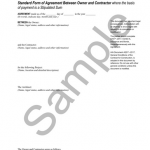
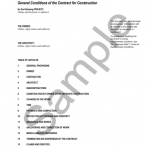
A101® – Agreement Between Owner and Contractor sets the contractor’s scope obligations. It incorporates a specific set of drawings and specifications prepared by the design team, as well as A201® – General Conditions of the Contract for Construction, which further defines the contractor’s responsibilities and interactions with the design team.
Contract Time: Milestones and Liquidated Damages
The contract time provision is essential for any construction project. Contract time defines the project’s timeline, including key deadlines and milestones, such as groundbreaking, topping out, substantial completion, and owner move-in dates. A clear timeline allows parties to track progress and keep the work on schedule.
Contract time typically begins with a Notice to Proceed issued by the owner or architect, which formally authorizes the contractor to start work. The Notice to Proceed date establishes the clock for all subsequent milestones and the substantial completion deadline.
Many construction contracts also include a liquidated damages clause, which sets a fixed daily amount that the contractor pays the owner if the project runs past the completion date. The amount should reflect the owner’s expected costs from project delays rather than serve as a penalty. Otherwise, a court may decline to enforce it. A liquidated damages clause should be carefully reviewed and negotiated because it will often represent a day-for-day fee that the contractor will be expected to pay for late performance. Liquidated damages can present significant risk to contractors, so they should be negotiated alongside other risk-allocation provisions. For example, in exchange for agreeing to liquidated damages, a contractor may be able to negotiate financial incentives for early project completion and a waiver of consequential (indirect) damages.
Contract Sum and Payment Terms
The contract sum is the total amount the owner will pay the contractor for completing the project. This section should specify the amount, the payment schedule, and how those payments are made. It should also define the pricing method, which usually falls under one of three categories:
- Stipulated sum, also known as a lump sum or fixed price
- Cost-plus, where the owner reimburses costs plus a fee.
- This kind of pricing commonly uses a guaranteed maximum price feature.
- Unit pricing, based on a set rate for each unit of work
Contractors submit payment applications using G702® – Application and Certificate for Payment, paired with G703® – Continuation Sheet. The architect reviews and certifies each application before payment is released. Most contracts also include retainage: a percentage of each progress payment, usually 5% to 10%, that the owner withholds until the work is substantially complete. Those funds protect the owner against incomplete or defective work and are released as part of the final payment.
Change Orders: How to Handle Modifications to Your Contract
Construction projects rarely unfold exactly as planned. The contract should explain how changes are requested, submitted, approved, and documented.
AIA contracts provide two ways to document changes: change orders and construction change directives.
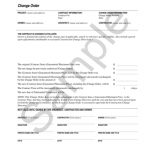
A change order, recorded on G701™ – Change Order, is a formal agreement signed by the owner, contractor, and architect that adjusts the contract sum, the contract time, or both.
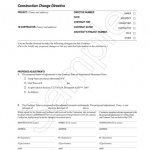
A construction change directive, recorded on G714™ – Construction Change Directive, lets the owner direct a change when the parties haven’t yet agreed on price or time, with compensation determined later.
Claims and Dispute Resolution: Resolve Issues Before They Escalate
Disagreements may be inevitable, but disorganization is not. A clear claims process keeps disagreements from becoming expensive disputes. AIA contracts establish a defined sequence.
Most issues go to the Initial Decision Maker first, who is usually the architect. If that doesn’t resolve it, the dispute moves to mediation through the American Arbitration Association, and then to binding arbitration or litigation, depending on what the parties agreed to.
This sequence lives in A201. Any owner-contractor agreement that incorporates it by reference automatically includes the process, keeping disputes from jumping straight to court.
Build Smarter with Standardized Construction Contract Terms
Scope, time, payment, changes, and dispute resolution are construction contract terms that affect whether a project stays on track. With an unlimited subscription, you get access to the full AIA document library, including A101, A201, G701, G702, G703, and 300+ other documents, so every project starts with standards-backed language trusted across the construction industry.