Construction projects involve multiple stakeholders, significant financial investment, and countless decisions before work ever begins. A well-written contract provides the foundation for managing those relationships by clearly defining responsibilities, allocating risk, and establishing expectations from day one.
AIA Contract Documents (ACD) have been the industry standard since 1888. They’re used on more than 200,000 construction projects each year, and their influence has shaped nearly every construction contract in the industry.
Rather than starting with a blank page or relying on outdated agreements, architects, contractors, subcontractors, suppliers, owners, consultants, and attorneys use coordinated, court-tested contracts that help projects run more efficiently while providing the flexibility to address project-specific needs.
Quick Reference Guide: Why Use AIA Contract Documents?
If you want to… | AIA Contract Documents help by… |
Establishing roles for every project participant | |
Using court-tested, standardized language | |
Assigning risk to the party best able to manage it | |
Allowing project-specific modifications | |
Providing agreements trusted across the construction industry |
What Is the Purpose of AIA Contract Documents?
AIA Contract Documents are legal agreements designed to help construction projects start with clear expectations and well-defined responsibilities. Instead of drafting contracts from scratch for every project, teams can build from standardized agreements that have been refined through decades of industry experience and legal precedent.
These agreements are designed to:
- Define the relationships between architects, contractors, owners, consultants, subcontractors, and other stakeholders
- Clearly assign responsibilities to reduce misunderstandings
- Establish consistent procedures for project administration
- Promote communication and collaboration throughout every phase of construction
- Establish a fair basis for risk allocation
Because the documents are coordinated across project participants, they help establish a consistent contractual framework that reduces disputes, improves efficiency, and reduces tedious and costly contract negotiations.
Who Creates AIA Contract Documents?
AIA Contract Documents are developed by the AIA Documents Committee, a group of more than 35 industry professionals representing diverse areas of the construction industry.
The committee includes:
- Architects
- Contractors
- Owners
- Construction attorneys
- Engineers
- Insurance professionals
These experts bring practical, real-world experience from projects across the United States. Working collaboratively, they develop and revise documents to reflect evolving construction practices, legal developments, and industry feedback.
Unlike contracts created by a single organization or individual, AIA Contract Documents are shaped by multiple perspectives to better serve the needs of the construction industry as a whole. The AIA Documents Committee also solicits and considers feedback from industry stakeholders throughout the development of each document. This industry outreach helps each document address the needs of the entire industry while remaining aligned with current practices.
How Are AIA Contract Documents Developed?
The development of AIA Contract Documents includes an extensive collaborative process, which is designed to produce practical, balanced agreements that reflect today’s construction environment.
1. Market Research
The process begins by gathering feedback from architects, contractors, owners, consultants, attorneys, and other construction professionals to identify emerging issues and industry needs. The committee also considers legal precedents established in recent case law issued by courts throughout the country as part of its document development process.
2. Industry Collaboration
The AIA Documents Committee works closely with subject matter experts, AIA member groups, and other stakeholders to evaluate proposed revisions and incorporate industry feedback.
3. Legal Consideration
AIA legal counsel works alongside committee members to help align the documents with current laws, court decisions, and construction practices. That said, AIA Contract Documents are not drafted to reflect the laws of any particular state, and neither the AIA nor the associated attorneys can provide professional or legal advice to anyone related to the contract. It’s important to consult a local attorney to review your specific project circumstances.
4. Committee Review and Revision
Drafts undergo multiple rounds of discussion, refinement, and revision before reaching consensus. The subcommittees host regular meetings to finalize language, approve documents, and discuss topics and trends to ensure the documents reflect the industry.
5. Continuous Updates
Construction continues to evolve, and so do AIA Contract Documents. Agreements are reviewed regularly to reflect changes in project delivery methods, technology, legislation, and industry best practices.
Are AIA Contract Documents Fair?
AIA Contract Documents are designed to create balanced agreements that allocate responsibilities and risk to the party best positioned to manage them.
Rather than favoring one project participant over another, the documents establish clearly defined obligations while allowing project teams to negotiate project-specific modifications when appropriate.
Every agreement is fully customizable, giving owners, architects, contractors, consultants, and attorneys the flexibility to address unique project requirements.
When modifications are made within the ACD platform, those changes remain transparent so parties can clearly identify revisions to the standard language.
Why Coordinated Agreements Matter
Construction projects rarely rely on a single contract.
Owners contract with architects. Architects contract with consultants. Owners contract with contractors. Contractors contract with subcontractors.
When these agreements are drafted independently, inconsistencies can create unnecessary risk, conflicting obligations, and communication challenges.
AIA Contract Documents are developed as coordinated agreements, meaning related contracts are designed to work together. Responsibilities, terminology, and project procedures are aligned across the project team, helping everyone operate from the same contractual foundation.
Benefits of coordinated agreements include:
- Consistent terminology across project participants
- Better alignment of responsibilities
- Reduced conflicting contract provisions
- Improved communication throughout the project
- More efficient contract administration
Key Benefits of Using AIA Contract Documents
Benefit | Why It Matters |
Predictability | Standardized language establishes clear expectations before work begins. |
Risk Management | Responsibilities are assigned to the party best equipped to manage them. |
Flexibility | Agreements can be customized to meet the needs of virtually any project. |
Coordinated Documents | Related agreements are designed to work together across the project team. |
Industry Standard | Trusted on more than 200,000 construction projects annually. |
Efficiency | Reduces the time required to develop contracts from scratch while maintaining consistency. |
How Are AIA Contract Documents Organized?
AIA Contract Documents are organized into document families based on project delivery method and project type.
Examples include:
- Traditional Design-Bid-Build
- Design-Build
- Progressive Design-Build
- Construction Manager as Adviser (CMa)
- Construction Manager as Constructor (CMc)
- Integrated Project Delivery (IPD)
- Residential Projects
- Interior Projects
- Modular Projects
Within each document family, administrative documents are designed to work together, making it easier to select coordinated agreements throughout the project lifecycle.
Who Uses AIA Contract Documents?
AIA Contract Documents are used by organizations across the construction industry, including:
Project Participant | Common Uses |
Owner-architect agreements, consultant agreements, project administration | |
Prime contracts, subcontracts, construction management agreements | |
Procurement, project delivery, and risk management | |
Consultant agreements and coordinated project contracts | |
Contract drafting, negotiation, and legal review | |
Reviewing and executing subcontract agreements |
How AIA Contract Documents Improve Construction Projects
Clear contracts create better projects. By establishing expectations before work begins, AIA Contract Documents help project teams delivering successful projects. This includes:
- Faster project execution with fewer contract-related delays
- Reduced disputes through clearly defined responsibilities
- Better communication among project participants
- More predictable project administration
- Improved accountability for every party involved
- Greater efficiency through standardized processes
While no contract can eliminate every challenge, establishing expectations early creates a stronger foundation for collaboration throughout the project.
Can AIA Contract Documents Be Customized?
Although AIA Contract Documents provide standardized language, they are intentionally designed to be customized for the specific needs of each project.
Whether you’re delivering a traditional design-bid-build project, design-build project, construction manager project, or another delivery method, agreements can be modified to address unique requirements while preserving the overall contractual framework.
Modifications made within the ACD platform remain transparent, making it easier for project participants to understand how the final agreement differs from the standard document.
For an additional mark of confidence, project teams can also generate certified documents, which verify the authenticity of the agreement and clearly disclose all modifications made to the governing contract.
Why AIA Contract Documents Continue to Be the Industry Standard
For more than 135 years, AIA Contract Documents have helped construction professionals establish clear expectations before work begins.
Their collaborative development process, court-tested language, coordinated agreements, balanced approach to risk allocation, and flexibility for project-specific needs have landed them among the most widely recognized contract families in the construction industry.
Whether you’re planning a residential renovation or a complex commercial development, choosing standardized agreements can help reduce uncertainty and support better project outcomes.
Build Your Next Project on the Industry Standard
Every successful project starts with choosing the right agreement.
With more than 300 coordinated contracts and forms covering virtually every construction relationship and delivery method, AIA Contract Documents help architects, contractors, owners, consultants, and attorneys establish clear expectations before work begins.
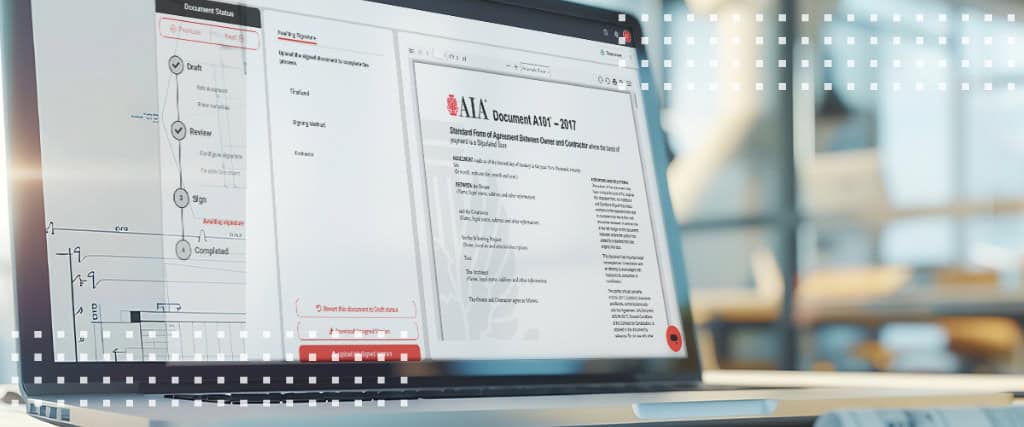
With an ACD subscription, you have access to the full library of documents, plus you can draft and edit agreements, collaborate with project teams, leverage AI Assistant to better understand contract language, and generate certified AIA Contract Documents with confidence, all in one platform.
Frequently Asked Questions
AIA Contract Documents are standardized legal agreements developed by the American Institute of Architects to help architects, contractors, owners, consultants, and other construction professionals define responsibilities, allocate risk, and manage construction projects.
AIA Contract Documents are developed by the AIA Documents Committee, which includes more than 35 architects, contractors, attorneys, owners, engineers, and insurance professionals representing the construction industry.
Yes. Once properly completed and executed by the parties, AIA Contract Documents become legally binding agreements.
Yes. They are designed to be customized for individual projects. Project teams can negotiate and modify provisions while maintaining transparency around those changes using the ACD platform.
They are developed collaboratively by industry experts, updated to reflect current practices, use court-tested language, coordinate relationships across project participants, and have been trusted throughout the construction industry for more than 135 years.
AIA Contract Documents are reviewed on an ongoing basis and revised as needed to reflect changes in construction law, project delivery methods, technology, and industry best practices.