
Construction disputes rarely start in a courtroom. More often, they only end up in a courtroom after they start on the job site when a change isn’t documented, a payment isn’t formally recorded, or a completion date is not formally established. No contract can eliminate every disagreement, but the right contract creates the processes and documentation that help prevent small issues from becoming costly disputes.
Contract management software can help you organize your documents and track what youāve signed. But software alone doesnāt change whatās actually in the contract, and it canāt create the processes that prevent disputes. Ā
A well-administered bad contract is still a bad contract. To best avoid disputes, the protection should be built into the document itself.
Quick Decision Guide: Is Your Project Protected Against Common Disputes?
Before work begins, confirm that your contract and project team have a process for documenting these common situations.
If your project needs to… | Use… |
Document changes to scope, cost, or time | |
Document payment requests and progress | |
Establish the official substantial completion date | |
Document minor field clarifications without changing cost or time | |
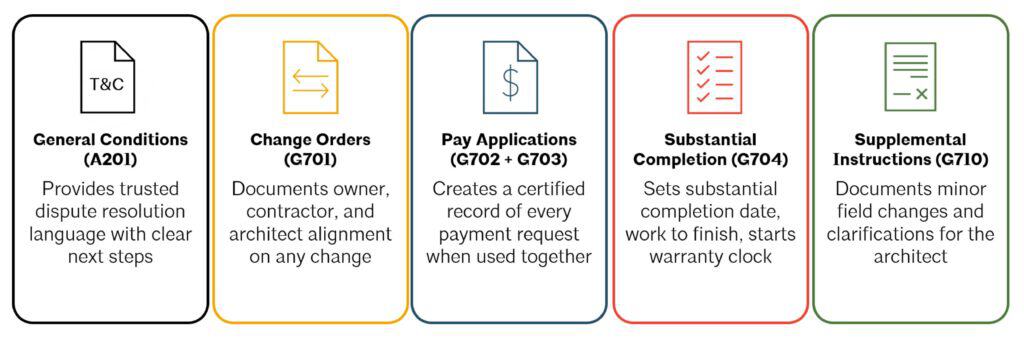
Define responsibilities and how disputes will be handled before work begins | A201® āĀ General Conditions of the Contract for Construction |
Key AIA Contract Documents That Help Prevent Construction Disputes
Where Do Most Construction Disputes Come From?
Many disputes trace back to a gap in documentation or process. Common triggers include:
- Changes that were requested but never formally documented before work proceeded.
- Payment amounts that parties remember differently because no certified record exists.
- Completion dates that were never officially established, leaving warranty and final payment timing open.
- Decisions that were made without a clear authority structure, so no one knows who had the final word.
Where these gaps exist, small disagreements can quickly escalate into bigger problems. And the cost is more than just legal fees. It’s delayed projects, damaged relationships, and time spent arguing instead of building.
The right contracts and administration forms close these gaps before work begins.
How AIA A201 Helps Resolve Construction Disputes
Most construction contracts include some form of dispute resolution language. A201Ā āĀ General ConditionsĀ structures the process to prevent escalation at every stage.
Every dispute follows the same defined path:
- Initial Decision Maker (IDM): The IDM, typically the architect, reviews claims, interprets the contract documents, and issues an initial decision. This step is required before either party can proceed to mediation. A defined decision-maker with authority to act quickly resolves most disputes before they grow.
- Mediation: If the IDM’s decision doesn’t resolve the issue, the parties move to mediation, a non-binding, collaborative, and significantly less expensive option than arbitration or litigation. A201Ā requires it before binding dispute resolution can begin.
- Binding Dispute Resolution: If mediation fails, the parties proceed to arbitration or litigation, as selected in the contract.
The result is a defined escalation path that every party understands before the project starts. Nobody needs to guess who needs to decide or what may happen next.
G-Series Forms That Prevent Construction Disputes
A201Ā establishes the rules. G-series contract administration forms create the written record that makes those rules enforceable. Used consistently, they close the gaps that cause most construction disputes.
AIA G701 ā Change Order
Scope changes are one of the most common sources of construction disputes, and most of those disputes trace back to changes that weren’t formally documented before work proceeded.
G701Ā requires written agreement from the owner, contractor, and architect before a change to scope, price, or contract time is executed. This three-party signature requirement is the key to dispute prevention. It forces alignment before work starts, not after.
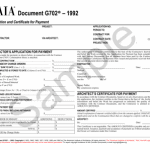
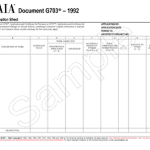
AIA G702 ā Application and Certificate for Payment and AIA G703 ā Continuation Sheet
Payment disagreements are another common source of construction disputes. G702Ā and G703 work together to prevent them.
- G702 is the cover sheet that documents the total payment requested, total certified, and retainage.
- G703 is the schedule of values breakdown showing what work was completed and at what value.
Together, they create an architect-certified record of every payment request. That certification matters because it’s a professional opinion that the work described has actually been completed and this holds up far better in a dispute than emails or memory. AIA pay applications are the industry standard for a reason; theyāve supported more than $1 trillion in payments processed across the industry, and payment disputes are much less likely when the paper trail is clean.
Best practice is to submit G702 and G703Ā together in every payment request. Inconsistent documentation creates gaps that are difficult to close after a dispute is filed.
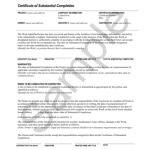
AIA G704 ā Certificate of Substantial Completion
Disputes about substantial completion are about three things at once:
- When the warranty period starts
- When final payment is due
- Who bears responsibility for damage after a certain date
Without a formal completion certificate, all three are up for debate.
G704Ā establishes the official date of substantial completion, lists the work still outstanding, and starts the warranty clock. Once it’s signed, the ambiguity is gone.
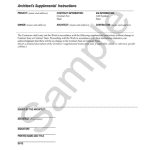
AIA G710 ā Architect’s Supplemental Instructions
Not every field change requires a change order. G710 lets the architect document minor changes that don’t affect cost or time. Without it, minor clarifications are communicated verbally or via email and can become disputed scope items.
Use G710 for minor field changes and clarifications. If a change turns out to affect cost or time, issue a G701 instead.
Build Dispute Prevention into Every Project
Construction disputes are easier to prevent than to resolve. A single undocumented change on a small project can turn into a dispute that costs more than the work itself. A201Ā and the G-series forms work together to establish clear responsibilities, document key decisions, and create a complete project record from groundbreaking to closeout.
With an AIA Contract Documents (ACD) subscription, you get access to the full AIA document library with more than 300 coordinated, standards-backed agreements and forms that help reduce risk on every project.