
Learn Resources – ACD

White outline icon of a hard hat.

General Contractor - Contract Resources

You’re coordinating the owner’s expectations, your subcontractors’ work, and the documentation behind every payment request. Your contracts need to support that work, not leave your team sorting out conflicting requirements in the field.

Find practical guides, articles, and videos from AIA Contract Documents (ACD) to help you clarify responsibilities and manage the contract decisions that affect your scope, schedule, and cash flow.

Essential Resources for General Contractors

Start with the big picture. Explore an in-depth explanation of construction contracts or follow a visual overview of the documents that support each stage of a project.

GUIDE

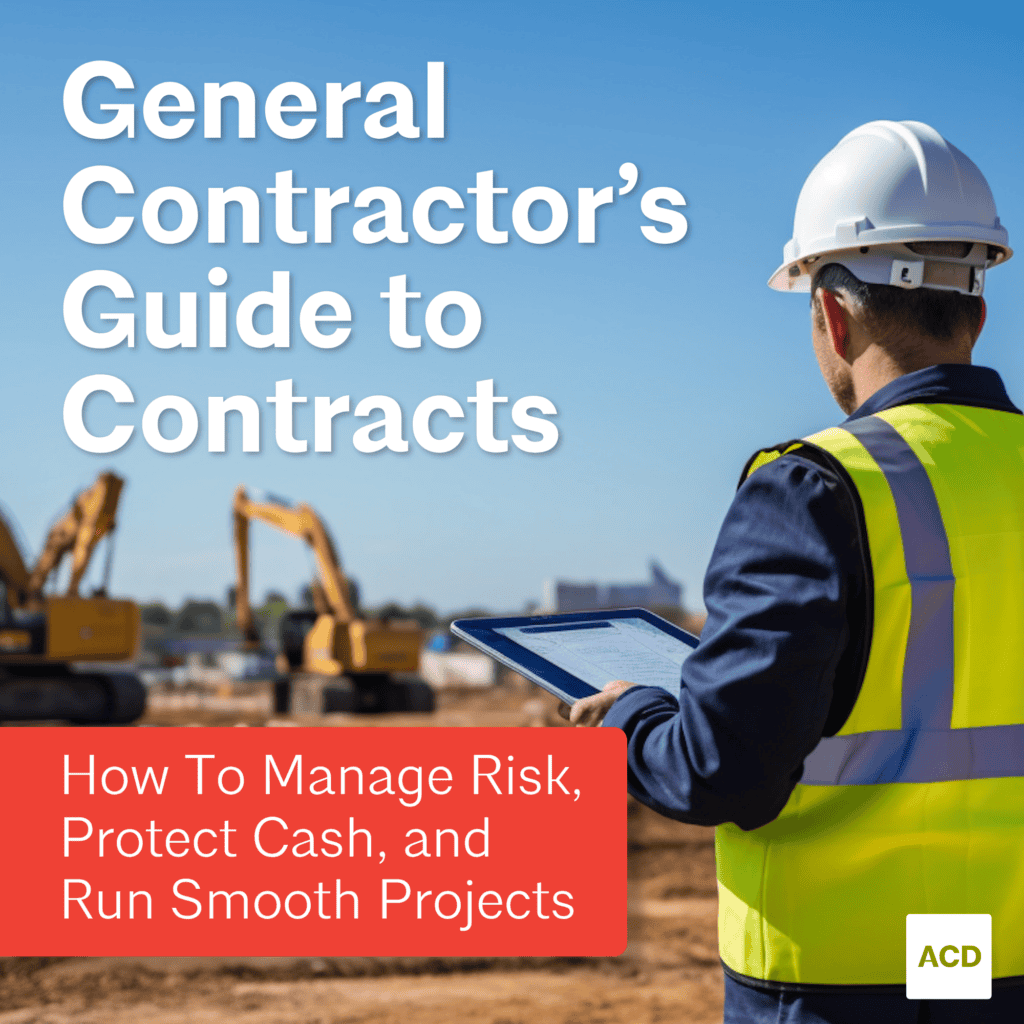
Cover of the General Contractor's Guide to Construction Contracts, showing a contractor in a hard hat reviewing plans on site.

General Contractor’s Guide to Construction Contracts

Understand the contract provisions that shape your responsibilities and your bottom line. Explore payment structures, project delivery methods, subcontractor coordination, and contract administration so you can ask better questions before signing and manage your obligations once work begins.

DOWNLOAD THE GUIDE

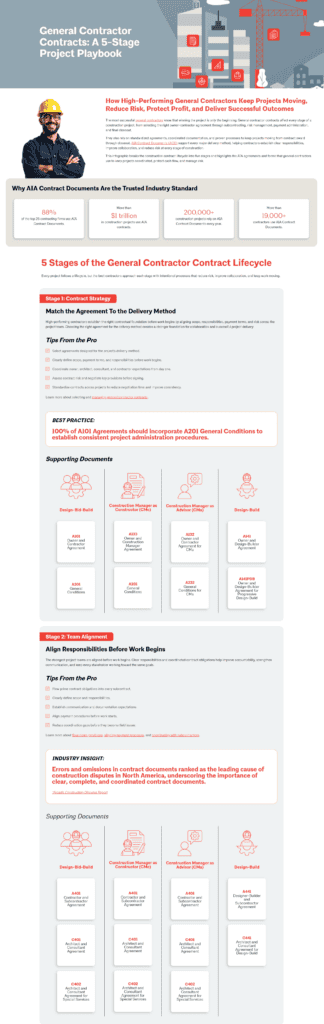
Preview of the General Contractor Contracts five-stage project playbook infographic, covering the contract lifecycle stage by stage.INFOGRAPHIC

General Contractor Contracts: A 5-Stage Project Playbook

See where contracts fit into the work ahead. Follow five stages of the construction contract lifecycle: contract strategy, team alignment, risk management, payment administration, and project closeout. Identify the agreements and forms that support your team at each stage.

 

VIEW THE INFOGRAPHIC

AI Insights for General Contractors

Watch to hear from ACD experts on how AI is changing construction for general contractors, and how you can use AI to manage risk.

Choose Contracts and Align Your Project Team

Before work starts, get clear on how your owner agreement, general conditions, and subcontracts fit together. Use these articles to connect the terms you negotiate with the responsibilities your team will manage.

Four construction professionals reviewing a tablet on site, aligning the general contractor contracts that keep work moving.

Essential AIA Contracts for General Contractors

Get an overview of key AIA document pairings for general contractors. See how A101 connects with general conditions, subcontractor agreements, bonds, and payment forms to support a coordinated approach to contract administration.

Excavators working a cleared site with a crew member nearby, the day-to-day work AIA general conditions govern.

A101 and A201: Connect Your Agreement to Project Administration

Understand the relationship between your owner-contractor agreement and the general conditions. Explore how A101 and A201 address business terms, project responsibilities, changes, payment review, and dispute resolution, plus questions to consider before work begins.

Hard hat and rolled drawings on a table while a crew reviews paperwork, the groundwork for subcontractor agreements.

A401: Align Subcontractor Agreements With Your Prime Contract

See how A401 connects subcontractor responsibilities with the A101 owner-contractor agreement and A201 general conditions. Explore the importance of coordinating scope, schedules, payment procedures, insurance requirements, and project documentation across your trades.

Matt Saw This Coming…

These construction mistakes cost the AEC industry millions every year. And they could have been prevented in the construction contracts.

Follow us for more construction tips from Matt.

Facebook icon linking to the AIA Contract Documents Facebook page. Instagram icon linking to the AIA Contract Documents Instagram account. TikTok icon linking to the AIA Contract Documents TikTok account. YouTube icon linking to the AIA Contract Documents video playlist.

Matt Saw This Coming

Getting Paid on Time and Managing Change Orders

Keep your payment requests moving with documentation that supports the work you’ve completed. Follow step-by-step instructions on how to prepare G702 and G703 payment applications, account for retainage and approved changes, and coordinate subcontractor billing so your submissions are complete, consistent, and ready for review.

A worker in a hi-vis vest types on a laptop, the kind of desk work that G702 and G703 payment forms require.

G702 and G703 Pay Applications for Contractors: How To Complete Pay Apps

Your payment request needs to connect completed work with your contract’s payment requirements. Learn how G702 and G703 work together and how to coordinate subcontractor billing, supporting documentation, and monthly submissions for a more consistent payment process.

Three workers in hard hats gather over a laptop and drawings on site, documenting a construction change directive.

Construction Change Directives vs. Change Orders: What’s the Difference?

When the scope changes, know how to document the work and its impact on your costs and schedule. Compare change orders and construction change directives, including when you may need to proceed before pricing and time adjustments are settled.

The Monthly Brief

Get expert insights, practical guidance, and the latest resources delivered to your inbox each month.
Enter your email to sign up now.

Why General Contractors Choose ACD

Learn from contractors facing the same demands you do: coordinating teams, managing project relationships and keeping work moving. Explore their experiences with AIA Contract Documents and find practical ideas for bringing more clarity and consistency to your own contract process.

NS Builders Logo

NS Builders: Simplifying Contracts and Subcontractor Coordination

As its residential business grew, NS Builders needed a contract process that could keep up. See how standardized AIA agreements and subcontractor work orders helped the team reduce administrative work, lower legal costs and bring more consistency to its projects.

Spyder Construction Logo

Spyder Construction: Building Trust and Winning Larger Projects

Learn how Spyder Construction moved beyond one-sided contracts to build stronger client relationships with balanced AIA agreements. Explore how clearly documented responsibilities and a more consistent contract process helped the firm demonstrate its professionalism and compete for larger, more complex projects.

Understanding Lien Waivers and Construction Bonds

Know what you’re signing, which rights you may be releasing, and what your project’s bonds are intended to address. Explore conditional and unconditional lien waivers, construction lien rights, and A312 payment and performance bonds to better understand the payment protections and responsibilities that connect you, your owner, your subcontractors, and your suppliers.

Excavators working a cleared site with a crew member nearby, the day-to-day work AIA general conditions govern.

Construction Lien Rights: How To Protect Payment

Understand who may have lien rights on your project and how unpaid work can affect funding and progress. Explore how construction liens work and why payment issues involving your subcontractors and suppliers can create challenges for the entire job.

Four construction professionals reviewing a tablet on site, aligning the general contractor contracts that keep work moving.

A312: Understand Payment and Performance Bonds

Learn the different purposes of payment and performance bonds and how A312 bond forms relate to your construction contract. Explore their role in supporting contractual commitments and addressing project performance and payment risks.

Browse All General Contractor Resources

Bring More Consistency to Your Contract Process

Give your team a consistent starting point for drafting, reviewing, and managing construction documents. An ACD subscription provides unlimited access to coordinated AIA agreements and forms, along with tools for editing, collaboration, and e-signatures.

Choose the documents that fit your project and build a contract process your team can repeat.

EXPLORE NOW

Frequently Asked Questions

Which AIA Contracts Should I Use for My Project?

Start with your project delivery method, payment structure, and role. Those choices help determine which agreements and supporting forms fit the job. The General Contractor’s Guide to Construction Contracts explains different contract structures and the responsibilities that come with them. No single agreement fits every project.

How Do I Keep My Subcontracts Aligned With My Owner Contract?

Start by understanding the obligations you’ve accepted in your owner contract, then review how applicable requirements relate to each subcontractor’s scope. Pay particular attention to schedules, payment procedures, insurance and documentation. The A401 subcontractor agreements article explains the connections among your owner agreement, general conditions and subcontracts.

Where Can I Learn About Construction Payment Applications?

Start with the G702 and G703 payment applications article. G702 summarizes your payment request, while G703 provides the supporting breakdown of work and values. The article explains how these forms connect project progress, stored materials, retainage and changes to your contract’s payment process.

Can These Resources Help After Construction Starts?

Yes. Your contracts remain relevant as you coordinate subcontractors, document changes, request payment and prepare for closeout. Use the five-stage project playbook to see how agreements and forms support the construction lifecycle, then explore individual resources as questions arise.